
AI “Ghost Designers”: The Rise of Co‑Pilot Collections
2/14/20264 min read
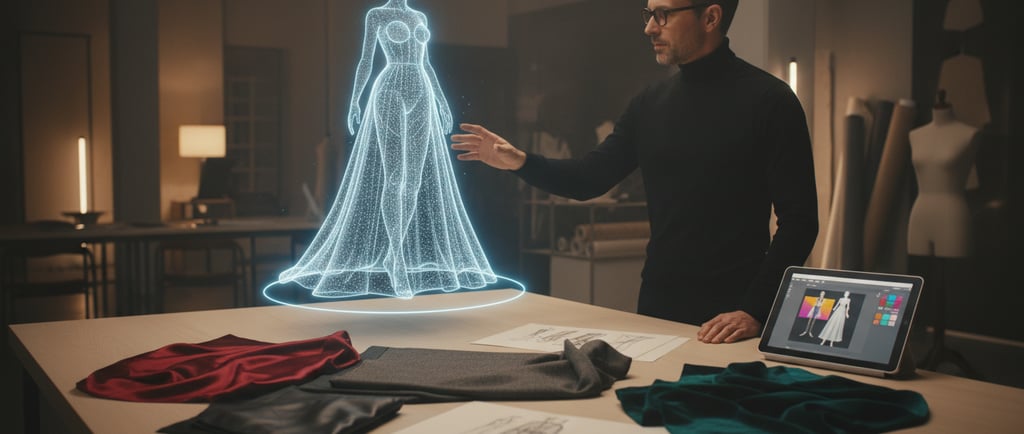
For decades, fashion design has followed a familiar rhythm: moodboard, sketch, sample, revise, produce. The cycle can take six months or more, and by the time a collection hits the floor, the cultural moment that inspired it may already be fading.
In 2026, that timeline is compressing—and not because designers are working faster. It’s because they’re no longer working alone.
Enter the AI “Ghost Designer”: not a replacement for human creativity, but a co‑pilot system that assists with ideation, manufacturability, and rapid iteration. These systems don’t just generate pretty sketches. They translate aesthetic direction into technical outputs, simulate fabric behavior, adapt silhouettes based on real-time trend data, and even prepare early-stage production specs.
The result is what some brands are calling Co‑Pilot Collections—lines developed in collaboration with AI systems that understand both creative intent and manufacturing reality.
From Moodboard to Manufacturable Concept
Traditional generative AI tools could already create striking fashion imagery. The limitation? Most outputs weren’t buildable. A sleeve might look dramatic but defy pattern logic. A neckline might be stunning but structurally unstable. A viral “aesthetic” might be trending online but completely incompatible with a brand’s production constraints.
AI ghost designers change the workflow by integrating three layers:
Visual inspiration input (moodboards, trend references, archival looks)
Technical garment knowledge (pattern construction, seam logic, grading rules)
Manufacturing constraints (fabric availability, cost targets, supplier capabilities)
Instead of producing fantasy garments, the system proposes pieces that align with real-world parameters: maximum fabric width, achievable seam finishes, or feasible trims. The designer remains in control, but the AI handles the combinatorial explosion of possibilities.
This is especially powerful for brands that operate on lean timelines. Instead of sketching ten blazer variations manually, a designer can review fifty viable silhouettes generated within minutes—each already filtered by cost ceiling or material library.
Generative Tech Packs: The Missing Link
One of the most significant bottlenecks in fashion is the tech pack—the technical blueprint sent to factories. Creating accurate measurement charts, seam instructions, and construction notes takes time and precision.
AI co‑pilot systems are now capable of generating early-stage Generative Tech Packs from approved concept designs. Using a trained understanding of garment anatomy, the system can:
Infer seam placement and stitching types
Suggest pattern segmentation
Estimate yardage requirements
Create base measurement sets across sizes
Flag structural weaknesses
Designers and technical teams still review and refine the output, but the first 60–70% of documentation can be automated. This dramatically reduces sampling rounds and communication lag between brand and factory.
The impact? A six-week development window can compress into two.
Trend-Responsive Micro-Collections
The speed advantage becomes most apparent in micro-collections.
Traditionally, reacting to a viral aesthetic required guesswork and risk. By the time production finished, demand might have evaporated. AI ghost designers analyze search trends, social engagement signals, and in-house sales data to identify rising silhouettes or color stories earlier.
For example:
A spike in “structured minimal outerwear” searches
Increased saves on wide-shoulder tailoring
Growing preference for muted olive tones
The AI can generate capsule concepts aligned with these signals—filtered through the brand’s established DNA—within days. Designers then curate, refine, and finalize a focused drop rather than gambling on intuition alone.
This doesn’t turn brands into trend-chasers. Instead, it equips them to respond surgically, with minimal waste.
The Human-in-the-Loop Advantage
Despite the automation, the best results still depend on human oversight. AI can propose volume shifts or collar reconfigurations, but it cannot replace a designer’s emotional judgment.
The last 10%—the nuance of proportion, the subtle adjustment that makes a garment feel “right”—remains deeply human. The co‑pilot model works because it removes repetitive groundwork while preserving creative authority.
Designers often describe the system as a collaborator that never tires. It can:
Offer unexpected silhouette alternatives
Test colorways instantly
Simulate drape under different fabric weights
Highlight structural tension points
But it doesn’t decide what feels culturally relevant or emotionally resonant. That discernment belongs to the creative lead.
Sustainability Through Precision
Speed alone isn’t the only benefit. Co‑pilot collections can reduce waste.
Because AI systems evaluate material availability and cost constraints early, fewer samples are produced blindly. Virtual sampling—complete with realistic drape and movement simulations—allows teams to kill weak concepts before fabric is cut.
Additionally, predictive demand modeling helps brands produce closer to actual demand curves rather than relying on broad forecasts. Micro-drops informed by data reduce overproduction and markdown risk.
The environmental benefit becomes a competitive advantage: agility without excess inventory.
Democratizing High-Level Design
AI ghost designers also level the playing field.
Historically, only large houses with extensive R&D teams could prototype at scale. Now, smaller DTC brands can experiment with silhouette libraries and technical variations without massive budgets.
This democratization doesn’t eliminate craft; it expands access to structured experimentation. A young brand can test three jacket constructions digitally before committing to one physical prototype.
In effect, the AI becomes an accelerator for creative iteration.
Risks and Guardrails
Like any powerful tool, AI co‑design systems carry risks:
Homogenization: Over-reliance on data-driven suggestions can flatten creativity.
IP boundaries: Systems must avoid generating designs too similar to existing protected work.
Over-optimization: Designing purely from performance data may sacrifice long-term brand storytelling.
To mitigate these risks, leading brands establish design governance frameworks:
Clear brand DNA documentation
IP similarity scanning
Human approval at final concept stage
Data weighting that prioritizes identity over virality
The goal is augmentation, not automation dominance.
The Competitive Edge
Co‑pilot collections represent a structural shift in fashion’s operating model. Instead of a linear pipeline—idea to production—brands move toward a feedback loop:
Inspiration → AI iteration → human refinement → digital validation → production → real-time data feedback.
This cycle can repeat multiple times within a single season.
Brands that master this loop gain three advantages:
Faster response to cultural shifts
Reduced sampling and waste
Higher alignment between creative vision and consumer demand
Conclusion: The Designer’s New Partner
The AI ghost designer is not the future creative director of fashion. It is the silent partner—handling structural logic, testing possibilities, and accelerating development so human designers can focus on storytelling, emotion, and brand identity.
Co‑pilot collections don’t remove artistry; they refine it. In a market where speed and sustainability define survival, the brands that embrace intelligent collaboration will shape the next generation of fashion—not by replacing designers, but by empowering them with tools that expand what’s possible.
Luxury
Elevate your brand with our exclusive AI models.
Contact us
Exclusivity
© 2026. All rights reserved.
(609) 901-8073