
AI‑Powered Resale: The “One‑Click” Circular Economy
2/16/20264 min read
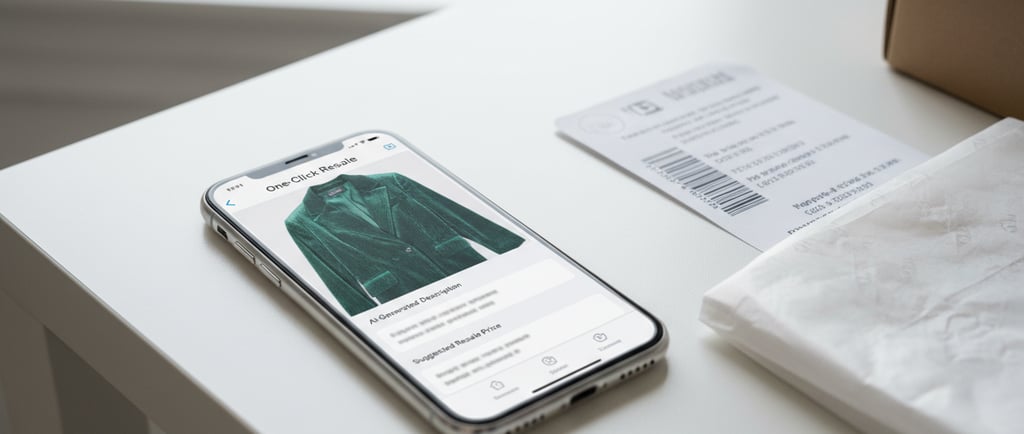
For years, the fashion industry has viewed the secondary market—resale—as a necessary evil or a third-party problem. Brands produced the goods, sold them once, and then watched from the sidelines as platforms like The RealReal, Vestiaire Collective, and Poshmark captured the entire lifecycle of the product thereafter.
But in 2026, the narrative has shifted. Resale is no longer a side hustle; it is a core pillar of a brand’s ecosystem. The barrier to entry for both brands and consumers has always been the "friction of the flip": the tedious process of photographing, describing, authenticating, and pricing a used item.
AI is systematically removing that friction. By automating the "last mile" of the circular economy, AI is enabling a One‑Click Resale experience that allows brands to reclaim their secondary markets, improve sustainability, and deepen customer loyalty.
The Friction Problem: Why Resale Was Hard
To understand the AI solution, we have to look at why resale was traditionally a chore. For a consumer to sell a jacket, they had to:
Find the original product name and details (often lost in an old email).
Take 5–10 high-quality photos that satisfy a buyer’s skepticism.
Write a compelling, accurate description.
Research the current market value to set a competitive price.
Prove the item isn't a counterfeit.
For the brand, the challenge was even greater: how do you verify the condition of an item you haven't seen in three years? How do you manage the logistics of thousands of unique, single-SKU items?
Auto‑Listing: From Purchase History to Marketplace
The most immediate breakthrough in AI resale is the Auto‑Listing. Because modern brands like Noir Starr maintain a "Digital Passport" for every item sold, the AI already knows the "DNA" of the garment.
When a customer decides to sell, they don't start from scratch. They go to their order history and tap "Resale." The AI instantly pulls the original high-resolution studio photography, the fabric composition, the size, and the original retail price.
The customer then takes a single "Condition Photo" using their smartphone. The AI analyzes this photo to detect signs of wear—pilling, fading, or stains—and automatically adjusts the description: "Excellent condition, minor wear on the left cuff." In seconds, a professional-grade listing is live, without the customer ever typing a word.
Visual Authentication: The AI Sentry
Counterfeiting is a multi-billion dollar problem that erodes trust in luxury resale. Traditionally, authentication required a human expert to physically inspect the stitching, hardware, and date codes.
In 2026, Multimodal AI has reached a level of precision where it can authenticate items via smartphone photos. By training on thousands of "macro" images of authentic hardware, zippers, and logo engravings, the AI can detect microscopic inconsistencies that the human eye might miss.
When a seller uploads their photos, the AI performs a real-time "Identity Check." It verifies that the grain of the leather matches the brand's standards and that the serial number follows the correct algorithmic sequence for that production year. This "AI Sentry" provides an instant "Verified Authentic" badge, giving the buyer confidence and the brand a way to protect its intellectual property.
Dynamic Resale Pricing: The "Stock Market" of Fashion
Pricing a used item is a guessing game for most consumers. If you price too high, it sits; too low, and you leave money on the table.
AI-driven Dynamic Resale Pricing functions like a stock market for fashion. The algorithm analyzes:
Current demand for that specific SKU across the web.
Recent successful sale prices for similar items in similar conditions.
Seasonal trends (e.g., coats sell for more in October than May).
The brand's current retail pricing for new versions of the item.
The AI suggests a "Sweet Spot" price that maximizes the chance of a sale within 48 hours. For the brand, this data is a goldmine—it reveals which items hold their value best, informing future design and production decisions.
The Brand-Owned Ecosystem: Why "Buy Back" is the New "Loyalty"
The ultimate goal of AI-powered resale is to bring the customer back into the brand's own ecosystem. Instead of selling on a third-party app for cash, brands are incentivizing "One-Click Resale" for Brand Credit.
When a customer sells their Noir Starr jacket back through the official site, they receive an instant credit that can be used toward the new collection. This creates a "Circular Loyalty" loop:
Customer buys a new item.
Customer wears it for two seasons.
AI suggests it's time to "refresh" and shows the current resale value.
Customer clicks "Resale," gets credit, and buys the next new item.
The brand wins twice: they capture the data (and often a small fee) from the resale, and they ensure the next purchase happens with them, not a competitor.
Sustainability as a Data Point
Beyond the economics, AI resale is the only way to truly measure a brand's sustainability impact. By tracking the "Second Life" of a garment, brands can report on actual product longevity.
AI can calculate the "Carbon Saved" by extending the life of a garment through resale, providing the brand with verified ESG (Environmental, Social, and Governance) data. This isn't just marketing; in 2026, it's a regulatory requirement in many markets. The AI turns "Circular Fashion" from a vague promise into a trackable metric.
Conclusion: The End of the "Dead" Closet
The "One-Click" circular economy is the end of the "dead" closet—the graveyard of unworn clothes that sit in the back of a wardrobe because they are too much trouble to sell.
By using AI to handle the photography, the description, the authentication, and the pricing, brands are turning every customer's closet into a liquid asset. It makes luxury more accessible, fashion more sustainable, and the relationship between brand and consumer more permanent. In 2026, the most successful fashion brands won't just be the ones that sell the most new clothes; they'll be the ones that manage the entire life of the garment, from the first stitch to the third owner.
Luxury
Elevate your brand with our exclusive AI models.
Contact us
Exclusivity
© 2026. All rights reserved.
(609) 901-8073