Brand-Safe “Sexy” With AI: Guardrails That Keep Content Hot, Not Risky
1/15/20265 min read
“Sexy” sells—especially in lingerie, swim, nightlife fashion, and glamour aesthetics. But in 2026, sexy content also lives inside a minefield: platform moderation, ad rejections, shadowbans, payment processor sensitivity, and brand trust issues when imagery drifts into “too much.”
AI makes this both easier and harder.
Easier because you can produce high-end visuals at scale with total control over styling, lighting, and creative direction. Harder because AI can accidentally generate the exact things that trigger enforcement: overly explicit anatomy, unrealistic nudity artifacts, “porn-coded” framing, underage-looking faces, or just enough weirdness to set off a moderation model or human reviewer.
The solution isn’t to “tone it down until it’s boring.” The solution is to build guardrails—a repeatable system that keeps your output premium and provocative, without being risky, inconsistent, or platform-hostile.
This is a practical blueprint for building brand-safe sexy AI content—especially for a Noir Starr–style noir-luxury aesthetic.
Important note (not legal advice)
Platform rules change often, and enforcement is inconsistent. Treat this as a production and risk-management framework, not legal advice. When in doubt, consult counsel and test content in controlled runs.
The Core Concept: “Sexy” Is a Spectrum—Risk Is Not
A common mistake is treating sexy content as a binary: safe vs unsafe. In reality:
Sexy is a spectrum of styling, pose, camera framing, lighting, and implied intimacy.
Risk comes from specific triggers—many of which are predictable.
Your goal is to define your brand’s “safe sexy zone” and then build a pipeline that stays inside it by default, while still giving you room for bolder editorial work where it’s appropriate (email campaigns, owned site, age-gated experiences, etc.).
What Makes AI “Sexy” Content Risky (The Real Triggers)
Here are the high-frequency failure modes that cause trouble for brands:
1) Explicit anatomy and “oops” exposure
AI can unintentionally:
reveal nipples or genitals
create see-through fabric that becomes “too revealing”
invent anatomy details that were never intended
Even if you didn’t prompt for nudity, the output can drift there—especially with lingerie, sheer mesh, and high-contrast lighting.
2) Underage ambiguity (the fastest way to catastrophic risk)
If a model looks too young (face, body proportions, styling), you risk severe enforcement and reputational damage. This is non-negotiable: your pipeline should be biased toward clearly adult aesthetics.
3) Porn-coded composition
Sometimes it’s not nudity—it’s framing:
overly explicit crotch-centered crops
“bedroom act” implication
exaggerated body angles that read as porn rather than fashion/editorial
Noir, glamour, and lingerie can stay premium—but camera language matters.
4) Uncanny artifacts that trigger moderation
Weird hands, warped anatomy, “melted” lace edges, unnatural skin sheen—these can look like manipulation or “explicit-adjacent” content to automated filters and reviewers. Uncanny is risky even when the image is covered.
5) Brand dilution
If you can’t keep model identity, lighting style, and wardrobe realism consistent, you create:
lower trust
lower conversion
higher platform scrutiny (because inconsistent content resembles spammy AI farms)
The Guardrails Stack: How to Keep It Hot and Controlled
Think of brand-safe sexy AI as a stack of controls. You don’t rely on one thing—you layer defenses.
Guardrail 1: A Written “Sexy Style Guide” (Your Creative Constitution)
Before prompts, define your creative rules in plain language. For Noir Starr–style content, this might include:
Coverage standards
nipples always covered
no visible genital detail
sheer panels allowed only when coverage remains clear
Pose rules
fashion/editorial posing (confident, composed)
avoid explicit spread, explicit bedroom positioning, or “act-implying” gestures
Camera rules
avoid hyper-explicit crops
prioritize waist-up, 3/4, and full-body editorial framing
allow “close” shots for fabric detail, not anatomy emphasis
Aesthetic rules
noir high-contrast lighting
premium textures (lace edge integrity, satin highlights controlled)
minimal backgrounds that signal “studio/editorial,” not “explicit scenario”
This style guide becomes your QA checklist later.
Guardrail 2: Identity + Age Signaling (Make “Adult” Unambiguous)
Your AI “models” should read clearly adult via:
facial structure (avoid overly youthful proportions)
styling (adult editorial hair/makeup)
wardrobe context (high-fashion lingerie styling, not teen-coded aesthetics)
Operationally:
maintain a curated roster of adult-presenting model identities
avoid “youth-coded” signals (very young-looking faces, school/uniform vibes, overly juvenile accessories)
This isn’t just about safety—it’s about brand tone. Noir Starr is luxury noir, not teen-coded anything.
Guardrail 3: Prompt Frameworks That Encode Taste
Instead of writing fresh prompts every time, build templates that systematically produce your desired look.
A strong “brand-safe sexy” prompt template usually bakes in:
editorial setting (luxury studio, noir lighting)
coverage rules (tasteful, non-explicit, fully covered)
pose intent (confident, fashion stance)
realism signals (skin texture, natural highlights)
negative constraints (no explicit nudity, no sexual act, no underage)
The point isn’t censorship—it’s consistency.
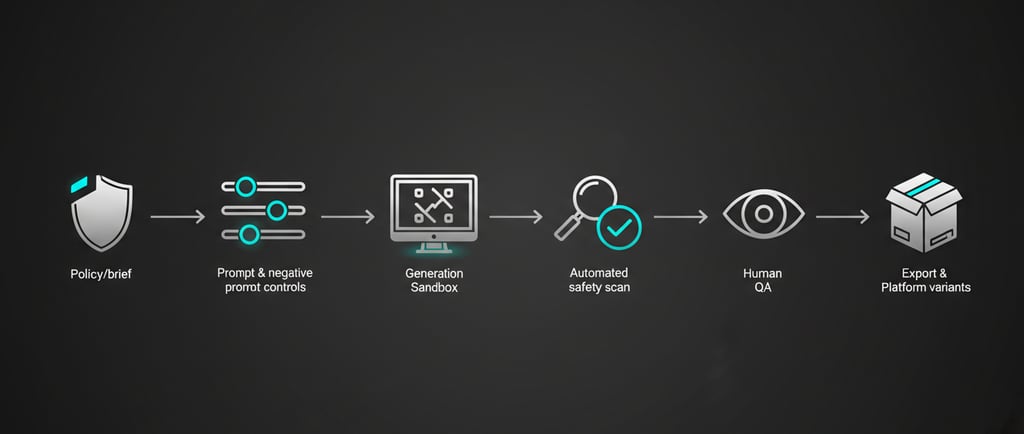
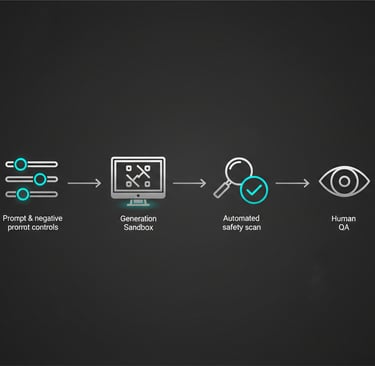
Guardrail 4: Generate in a Sandbox, Not Straight to Production
Never generate directly into your live asset folder. Use a sandbox stage:
Batch generate candidates
Score them quickly (composition, vibe, garment realism)
Discard aggressively
Only send winners to refinement/inpainting
This avoids “one bad output accidentally gets published” chaos.
Guardrail 5: Automated Safety Scans (Fast Triage)
Even if you have human review, automated checks help you scale without relying on someone’s tired eyes at 1 a.m.
Automated scan goals:
detect potential nudity exposure
flag risky crops and overly explicit focal points
catch obvious artifacts (melted hands, warped anatomy)
enforce “no minors” heuristics (where possible)
Treat automation as triage, not truth.
Guardrail 6: Human QA With a Conversion Lens
Human QA is where you protect:
brand tone
ad-account health
customer trust
Use a two-pass QA:
Pass A: Safety
coverage confirmed
pose/crop not explicit
no “scenario” implying sex acts
no minors / no youth-coded vibe
Pass B: Quality
face realism + eyes (no “dead eyes”)
hands + anatomy integrity
fabric edges (lace, mesh, straps)
lighting consistency (Noir Starr house look)
If an image is “almost perfect but risky,” don’t publish it. Fix it (inpainting) or kill it.
Platform Strategy: One Shoot, Multiple Variants
A major advantage of AI is versioning.
You should not have “one image.” You should have:
PDP version (most tasteful, cleanest framing)
Paid ad version (more conservative crop/pose, more negative space)
Organic social version (editorial, mood-forward)
Email/owned version (can be bolder, still tasteful)
Same outfit. Same model. Same lighting. Different risk profiles.
That’s how you stay hot without losing distribution.
The “Hot, Not Risky” Aesthetic: What Works for Noir Starr
If your goal is luxury noir glamour that still passes brand safety, focus on:
Implied sensuality over explicit exposure
blazer draped over lingerie
silhouette + rim light
close-ups on lace texture, not anatomy
Editorial posture
confident stance beats explicit posing
fashion gaze and styling beats “act-coded” framing
Premium lighting discipline
harsh overhead lighting can look cheap/risky
controlled noir rim light looks expensive and safer
Sexy that looks expensive reads as fashion. Sexy that looks cheap reads as adult content. That difference matters.
A Practical Guardrails Checklist (Use This Every Batch)
Before publishing, confirm:
Model reads clearly adult (face, styling, proportions)
Coverage is unambiguous (no accidental exposure)
No explicit or porn-coded crop/pose
Lingerie construction looks physically plausible (straps, seams, lace edges)
Hands/eyes/anatomy are natural (no uncanny artifacts)
Lighting matches brand (no flat “AI studio” look)
Exported variants exist for each channel (PDP / ads / organic)
Closing: Guardrails Don’t Kill Sexy—They Make It Scalable
The brands that win won’t be the ones that avoid sexy content. They’ll be the ones that can produce sexy content reliably, at scale, without triggering enforcement or eroding trust.
Guardrails aren’t a limitation—they’re what turn AI glamour from “cool experiment” into a real commercial engine.
Luxury
Elevate your brand with our exclusive AI models.
Contact us
Exclusivity
© 2026. All rights reserved.
(609) 901-8073