
Can AI models make fashion more diverse or less diverse?
1/2/20268 min read
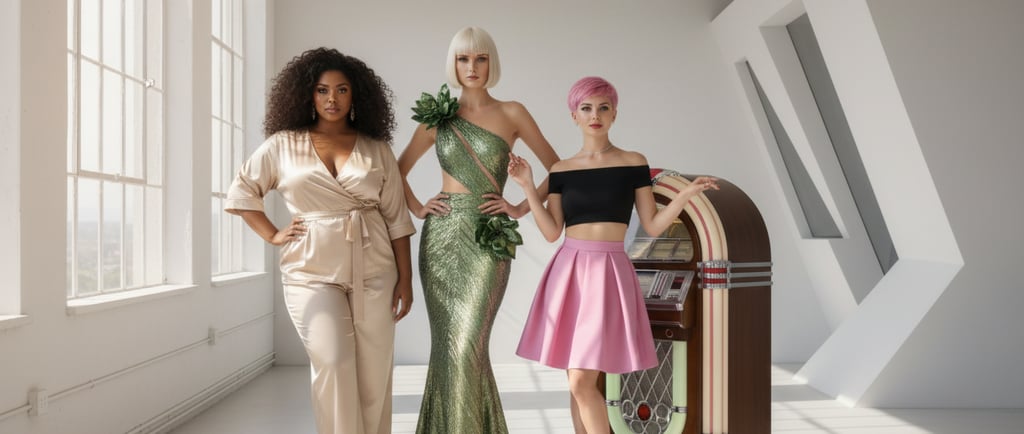
Fashion and advertising have had to face a hard truth over the past ten years: beauty has been defined in a way that is too narrow for too long. Limited range of sizes. One main skin tone in ads. Hair textures that don't look like real life at all. Casting choices that leave whole communities out of the picture.
AI-generated models are the newest addition to the industry.
AI models look like the best answer at first glance. With the right tools, a brand can make models of any skin tone, body type, age range, or cultural style right away. No costs for travel. No problems with casting. Looks that never end. This sounds like a dream for diversity and inclusion on paper.
But there's a problem.
The same technology that could greatly increase representation can also quietly reinforce the same old biases, but faster and on a larger scale.
This article will look at a question that is at the heart of the AI model revolution: can AI models really make fashion more diverse, or are they more likely to make things worse? So, how can brands use sites like Noir Starr in a responsible way to stay on the right side of that line?
How Bias Shows Up in Traditional Fashion, and Why AI Won't Fix It Right Away
Before we talk about AI, let's be clear about the kinds of problems that have always been a problem in fashion and advertising.
1. Narrow standards of beauty
For decades, casting has been biased toward:
Thin, often very specific body shapes
Young-looking faces
Facial features that are Eurocentric
Lighter skin tones are the most common in mainstream campaigns.
Even when brands "diversify," they usually only do so within a small range of what is thought to be "safe" for business.
2. Structural problems in the modeling pipeline
Bias isn't just about who is in the final campaign. It's also about:
Who signs the agencies
Which models are pushed for high-end campaigns
Which clients are "right" for which faces and bodies
AI doesn't get rid of those power dynamics on its own; it just changes the tools.
3. The false sense of variety
Some campaigns add diversity as a visual checkbox, like one model with darker skin and one model with a larger body type, but the brand's main style and message still focus on one ideal. Representation turns into decoration instead of a real change in point of view.
If AI learns from pictures made by this system, it could learn the same hierarchy: which faces are in the spotlight, which are pushed to the side, and which are completely hidden.
Where AI models can really improve representation
Even with those risks, AI models can do things that traditional pipelines can't do as well when they are designed and used carefully.
1. Unlimited casting choices that aren't limited by location
A brand no longer has to depend on who is available in a certain market, on a certain date, and with a certain amount of money. With AI:
You can show off your clothes on a lot of different body types at once.
In one campaign, you can show off different ethnic backgrounds and styles.
You can try out age diversity without worrying about how to find niche talent quickly.
This isn't just for looks. When a customer sees someone who looks like them wearing your product, they are more likely to buy it and trust your brand more.
2. Better size and fit representation for online shopping
One of the most useful ways to use AI models is to create images for online stores. AI makes it possible to do more than just one standard size-XS sample shoot:
The same piece of clothing shown on people with different body types and sizes
Realistic changes in fit and drape
Styling that shows off the different lifestyles and identities of customers
This is a change for shoppers who have never seen their body type on a brand's product page. Instead of "I'll guess and hope it fits," they can now say, "This brand really thought of me."
3. Testing ideas that include everyone more quickly
It's risky to suggest a bold, diverse campaign because what if the client doesn't "get" it? What if the agency is too careful?
Creative teams can:
Quickly come up with ideas for inclusive campaigns
Show clients side-by-side comparisons of traditional casting and diverse casting.
Use A/B test data to show that a wider range of people does better.
This turns diversity from just a moral argument into a strategic benefit backed by performance metrics.
How AI Can Quietly Make Diversity Worse
If brands and creators aren't careful, the same flexibility that makes AI powerful can also hide harmful patterns.
1. Training data that gets rid of some identities
Most AI systems learn from pictures that are already out there, like editorials, catalog photos, user-generated content, and more. If those sources are biased toward:
Lighter skin
Thin bodies
Some facial structures
Beauty standards that are based on Europe
Then the model's "default" output will follow those trends. Diversity must be intentionally integrated into the system; it will not arise spontaneously.
Without careful curation, AI will:
Autocomplete that leads to narrow beauty standards
Not enough of some ethnic groups are represented
Have trouble with certain types of hair, facial features, or cultural styles
You can tell this is happening when generic prompts keep making the same "type" over and over.
2. Tokenism on a large scale
If a brand only uses AI to "check the diversity box," that's tokenism, and now it's possible to do it over and over again.
Some examples are:
One AI model with darker skin fell into a sea of models with lighter skin.
Plus-size AI models were only used for "body positivity" posts, never for the main campaign.
Queer or gender-nonconforming styles are seen as a seasonal trend instead of being a part of the brand's core.
With AI, it's easy to make a few "diverse" images for a one-time campaign without changing the brand story at all.
3. "Perfection" that isn't real and is bad for you
AI can easily smooth out textures, make waists smaller, make eyes bigger, and in general make faces and bodies look like they are trying to reach an impossible ideal. If this isn't stopped, it can:
Make diversity only skin-deep (different skin tones, but the same body and face proportions)
Get rid of real human texture by flattening wrinkles, scars, and stretch marks.
Reinforce the notion that all bodies must adhere to identical symmetry and proportions to be deemed "beautiful."
This can be especially dangerous for younger people and for groups that are already left out of beauty conversations.
What Noir Starr Thinks Responsible AI Model Diversity Looks Like
We at Noir Starr believe that AI models should make more things possible, not limit the world to one algorithmic beauty standard.
Here are some important ideas that should guide an ethical and diversity-focused approach to AI modeling:
1. Diversity should be the first thing you think about, not the last.
We don't see diversity as just an extra layer on top of a generic output. We ask:
Who isn't in this picture story?
Whose body types, hair types, and features are not often the focus of mainstream campaigns?
Are we making the same kind of face and body over and over again, with only small changes to the surface?
The goal is to have campaigns that feel truly multi-dimensional, not just artificially diverse.
2. Representation in more than one way
Diversity isn't just about race. We take a look at:
Color and undertone of the skin
The shape and features of the face
Size, shape, and height of the body
Types of hair and how to style it
How people express and identify their gender
Different ages
That doesn't mean that every campaign has to have everything. But you should see a real range across a brand's ecosystem, which includes its website, ads, social media, and lookbooks.
3. Respect for other cultures, not taking them over
AI makes it easy to mix and match clothes, symbols, and styles from all over the world, but that power comes with a lot of responsibility.
A responsible AI modeling practice means:
Not showing cultural clothing in a way that is too stereotypical or cartoonish
Styling clothes with respect and context, not as "exotic flavor."
Avoiding using sacred symbols or clothing as decoration
When in doubt, brands should talk to people from the cultures they are trying to show.
4. Realism without erasing
Yes, AI can make pictures look very polished. But using it ethically means being careful:
Keeping the natural texture of your skin, like pores, freckles, and smile lines
Showing stretch marks, scars, and other real features when they are needed
Not doing aggressive "slimming" or making all models look the same
The goal is not to be perfect. It's important to be relatable and real.
How Brands Can Use AI Models to Really Make a Difference in Diversity
If you're a brand owner, marketer, or creative director thinking about using AI models, here's a useful framework to help you get started.
Step 1: Set clear goals for your representation from the start.
Instead of saying, "We just want cool AI models," say:
Who are the real customers we have?
Who have we missed in our visuals in the past?
What does meaningful representation look like in our field, like fashion, beauty, fitness, luxury, etc.?
Make those answers into clear rules. For instance:
"Every collection launch has at least three different body types."
"Our campaigns always have a good mix of skin tones."
"We will show the age range of our real customers in our visuals."
Step 2: Look over your current visual library
Take a look at your website, ads, and social media feeds as if you were a stranger:
Whose bodies and faces are the most important?
Who shows up every now and then and who shows up all the time?
Are some groups always put in "special topics," like only in posts about "body positivity" or "diversity"?
This audit will show you where AI models can really help instead of just making things worse.
Step 3: Use AI to test and show that ideas are inclusive
Collaborate with an AI model partner to:
Make different versions of the campaign that are open to everyone.
Try out different combinations of models and ideas in an A/B test.
Keep an eye on performance metrics like CTR, engagement, behavior on the site, and conversion.
It's much easier to make diversity a must-have in every campaign when the data shows that images that include everyone do better.
Step 4: Don't make diversity a one-time stunt; make it a permanent part of your brand.
The biggest change happens when:
Your fit guides show more than one body
The banners on your homepage show a wide range of images.
When budgets get tight, your paid ads don't go back to the "safest" look by default.
AI speeds up the process of making content, which makes it easier to keep this level of consistency without raising costs too much.
Diversity and AI Models in the Future: A Choice, Not a Guarantee
AI isn't good or bad by nature. It makes things louder.
If it is based on narrow ideas of beauty and used without thinking, it will:
Bias in scale
Make tokenism easier
Make brands look like they're making progress without actually changing.
But AI can do the following if it is made and used carefully:
Bring to light identities that have been underrepresented for a long time
Help people finally see themselves in the brands they love.
Provide creatives with a quick and adaptable toolkit for telling stories that include everyone.
We think that the future of fashion and advertising is hybrid, with people, AI models, and smart brands working together to tell more interesting and honest visual stories.
The question isn't if AI models will change the way fashion looks; they already are.
The real question is: who will be in charge of making them?
Luxury
Elevate your brand with our exclusive AI models.
Contact us
Exclusivity
© 2026. All rights reserved.
(609) 901-8073