Digital Twins and Legacy: Training AI Models on Iconic Supermodels of the Past (Without Repeating the Industry’s Worst Mistakes)
1/28/20266 min read
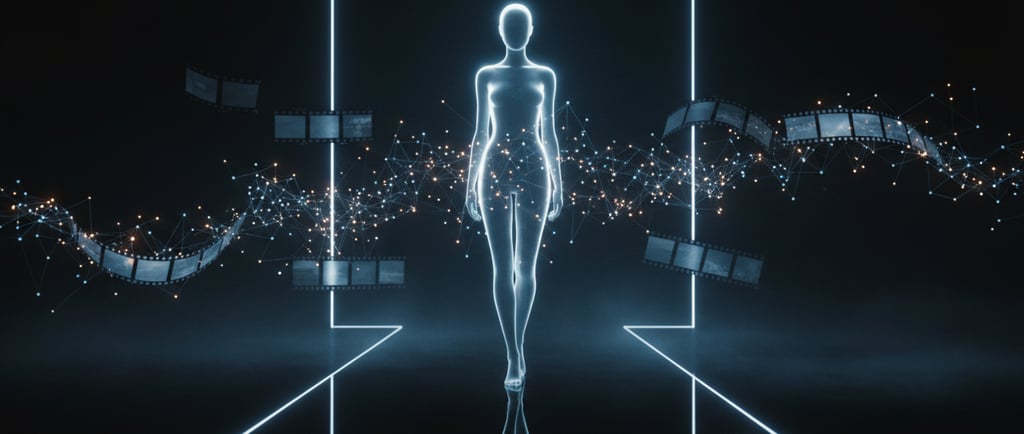

Fashion has always been a legacy business. A single face can define a decade, a walk can become a signature, and a campaign can outlive the product it sold. That’s why the idea of digital twins—AI models trained to reproduce a person’s likeness, motion, and “presence”—is simultaneously seductive and combustible in the fashion model industry.
On the seductive side, digital twins promise continuity: the ability to preserve a model’s signature look, reuse archival aesthetics, and produce new creative with less friction. On the combustible side, they raise hard questions about consent, ownership, compensation, authenticity, and reputational risk—especially when the “source” is an iconic supermodel from the past, whose likeness is culturally valuable and commercially potent.
This isn’t just a tooling trend. It’s a shift in what the industry treats as an asset. Historically, the asset was the relationship: model ↔ agency ↔ brand. Increasingly, the asset becomes a bundle of data + rights + weights + governance, packaged into something that can travel across time, geography, and production workflows.
This post breaks down what “training on iconic supermodels of the past” really means in 2026: the technology behind it, why it’s happening, what business models are emerging, and what a responsible path looks like for agencies, platforms, and brands.
What is a “digital twin” in the fashion model industry?
In casual conversation, “digital twin” can mean anything from a photoreal avatar to an AI face that resembles a real person. In a fashion-model context, it usually sits on a spectrum:
Look-alike synthetic model: a new identity that’s “inspired by” an era or vibe, but not a real person.
Authorized likeness model: a model trained on a specific person’s images/footage with explicit permission (and typically contractual restrictions).
Full performance twin: likeness + voice + gestures + expressions + walk + signature posing patterns, designed for production use.
Archive-driven twin: trained heavily on historical campaigns and runway footage—often where the rights are complex and the stakes are high.
The more “complete” the twin, the more valuable it can be—and the more dangerous it becomes if rights, security, and governance aren’t airtight.
Why now: the AI model industry is making “legacy” programmable
The AI model industry has matured to the point where it can capture and reproduce consistent identity traits across many outputs. That matters because fashion’s commercial workflows demand repeatability:
A brand wants a recognizable face across multiple deliverables.
Agencies want predictable quality at scale.
Editorial teams want coherence: lighting, skin texture, silhouette, and mood all aligned.
What changed is that identity consistency used to require a human and a schedule. Now identity can be stored, versioned, and deployed—like software.
This creates a new possibility: a supermodel’s “market presence” can be extended beyond traditional constraints. It also creates a new temptation: using the past as a content mine, where archives become training fuel.
The data problem: archives are powerful and messy
Training AI on iconic supermodels of the past implies using “legacy data,” which often includes:
Magazine scans, contact sheets, campaign stills
Runway video, backstage footage, interviews
Behind-the-scenes photography from photographers, stylists, and agencies
Brand-owned assets with restrictive usage clauses
Fan reposts and unlicensed compilations (a legal and ethical minefield)
Even when the images are “everywhere,” rights are not automatically cleared for model training or synthetic generation. And even when the model herself consented to a shoot decades ago, the contract likely didn’t contemplate AI replication.
This creates a central tension: the best data for a high-fidelity twin is often the hardest to use legitimately.
The core ethical question: is legacy being preserved—or extracted?
There’s a meaningful difference between:
Preservation: a model (or estate) chooses to create an authorized twin with controls, payment, and clear limits.
Extraction: a company trains a model on public imagery and monetizes the likeness without permission.
In fashion, extraction risk is amplified because the “value” is the person’s identity and cultural capital. If the industry treats iconic faces as raw material, it’s not just a legal exposure—it’s reputational dynamite.
The responsible approach starts with a principle: no authorization, no twin. That applies doubly when the person is not actively participating (retired, unreachable, or deceased).
Business models emerging around authorized digital twins
When done ethically, digital twins can be a new revenue stream—and potentially a new form of worker protection. Several monetization patterns are showing up:
Licensing by campaign / region / duration
A brand licenses the twin for a specific use: e.g., EU-only ecommerce visuals for 6 months.Usage-tier licensing
Lower tier for internal mood-boarding; higher tier for public advertising; premium tier for moving video and voice.Residual-style compensation
The twin generates ongoing usage fees similar to usage rights in photography—aligning incentives over time.Exclusivity packages
A brand pays for exclusive access to a twin for a season or category, similar to exclusive contracts in traditional modeling.Agency-managed “twin rosters”
Agencies represent digital twins as they represent talent—negotiating terms, protecting brand alignment, and controlling distribution.
For the fashion model industry, the biggest shift is that “representation” may include not only humans, but also model versions—v1.2, v1.3—each with documented capabilities and restrictions.
Governance: the contract is not enough without technical control
Even with solid contracts, AI introduces a practical reality: files can leak, models can be copied, and outputs can be repurposed.
A serious digital twin program needs both legal and technical governance:
Access control: who can generate, export, and publish outputs
Audit logs: traceability for when and how the twin was used
Model “scoping”: guardrails on what the twin can produce (nudity, sensitive categories, political contexts, etc.)
Content provenance: internal watermarking or provenance metadata to prove an output came from an authorized system
Revocation: the ability to withdraw access quickly if a partnership ends
Security posture: adapters/checkpoints handled like crown jewels, not like design files
In other words, if a digital twin is valuable, treat it like valuable IP—because it is.
Brand risk: the twin can damage the model, and the model can damage the brand
Brands often think of AI risk as “we might get sued.” In fashion, there’s another layer: identity risk.
A digital twin can be used to generate scenarios that never happened:
controversial styling
inappropriate contexts
misleading endorsements
altered body proportions that violate the model’s standards
content that breaks a luxury brand’s image consistency
Even if a brand didn’t publish it, internal misuse can leak. That’s why governance must include human approval workflows and strict separation between exploration environments and production outputs.
From the model’s perspective, the risk is existential: a twin could become a permanent “shadow self” that shows up in contexts they would never choose.
The estate question: what happens when the source is deceased?
Training on iconic supermodels “of the past” inevitably raises a scenario: posthumous digital twins.
This is where the industry needs its highest standards. A workable model typically requires:
explicit estate authorization
clear creative boundaries (categories, tone, brand fit)
transparent labeling and provenance
compensation routes that honor the legacy rather than opportunistically exploiting it
Even when legal permission exists, the ethical bar should be higher than “allowed.” Fashion trades on myth. Mishandling a legacy doesn’t just cause backlash—it damages cultural trust in the entire ecosystem of AI fashion models.
The “authenticity” debate: do digital twins cheapen fashion?
Critics argue digital twins are a shortcut: replacing craft with synthetic content, replacing human presence with a simulation. Supporters argue they can be used like any other medium—photography didn’t kill painting; CGI didn’t kill cinema; it expanded the palette.
The truth will depend on execution. In luxury especially, value comes from intention and control. A twin used as a carefully governed creative instrument can preserve an aesthetic lineage. A twin used as a content mill will cheapen everything it touches.
The winners will be the organizations that treat digital twins as:
a representation problem (not just a generation problem)
a rights problem (not just a data problem)
a reputation problem (not just a legal problem)
What Noir Starr–type platforms can lead on
For platforms and agencies operating in the AI fashion model industry, there’s a clear lane to lead:
Consent-first digital twin standards (what “authorized” means, and how it’s verified)
Transparent licensing that mirrors the clarity of traditional usage rights
Provenance tooling so brands can prove content origin
Safety and brand-alignment controls built into the generation pipeline
Fair compensation mechanics that don’t disappear once the model becomes “software”
In a market racing toward scale, trust becomes the differentiator. The platform that can say “this twin is authorized, governed, and auditable” will win premium clients.
Practical checklist: if you’re considering a legacy digital twin
If you want to explore a digital twin built on a legacy identity, here’s the operational checklist:
Rights audit: do you have training rights, not just publishing rights?
Consent scope: what categories, markets, and durations are permitted?
Data curation: source-controlled dataset with documented provenance
Model architecture choice: keep the “style” in modular adapters when possible
Evaluation: tests for likeness drift, body integrity, and brand consistency
Security: locked storage, limited export, rotating credentials
Human approvals: editorial gate before anything public
Revocation plan: how you shut it down if needed
Labeling policy: when and how you disclose synthetic use
Compensation: a structure that respects the person as the asset
The bottom line
Training AI models on iconic supermodels of the past is not just a technical trend—it’s a cultural and commercial reorganization of what “a model” is. In the best case, digital twins become a respectful form of preservation: authorized, governed, compensated, and creatively meaningful. In the worst case, they become extraction machines that convert legacy into content and trust into backlash.
The industry can choose which future it wants. And the organizations that win won’t be the ones generating the most images—they’ll be the ones that build the cleanest rights, the strongest governance, and the most defensible trust layer around digital identity.
If you want, I can also turn this into a SEO-ready package (title tag options, keyword cluster, internal link suggestions for Noir Starr, and a featured snippet paragraph) while keeping it strictly focused on the AI fashion model industry.
Luxury
Elevate your brand with our exclusive AI models.
Contact us
Exclusivity
© 2026. All rights reserved.
(609) 901-8073