Diversity in Virtual Models: Creating Inclusive Model Sets Without Tokenism (and Without Losing Brand Cohesion)
1/16/20265 min read
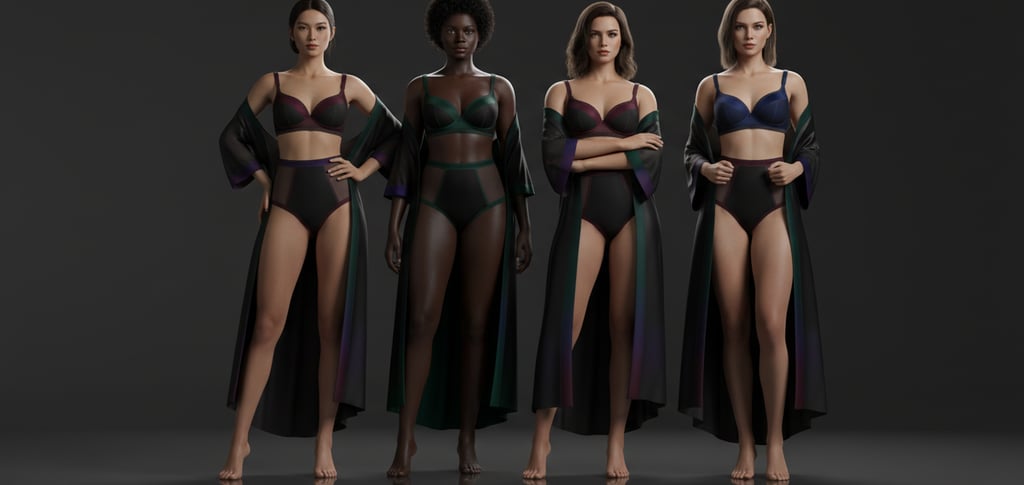
As brands shift from traditional photoshoots to AI-powered “promptshoots,” one question is becoming impossible to ignore:
How do you build truly diverse virtual model sets—different bodies, skin tones, ages, and identities—without slipping into tokenism or losing your brand’s visual cohesion?
For lingerie, swim, and glamour brands like Noir Starr, this question is even sharper. The imagery is intimate. The body is the product canvas. If diversity feels like an afterthought or a checkbox, customers notice. If everything looks the same, they also notice—and many will quietly leave.
This isn’t just a morality or PR issue. It’s:
a conversion issue (more people buy when they feel represented),
a retention issue (loyalty grows when people see themselves in your visuals),
and a brand equity issue (lazy diversity looks cheap, and cheap looks don’t command premium pricing).
Virtual models give you an enormous opportunity: you’re no longer constrained by who can show up to set. But without intention and structure, AI diversity easily becomes surface-level and inconsistent.
This article walks through how to create inclusive, non-tokenistic, and visually cohesive virtual model sets—especially in a noir-luxury, lingerie-forward aesthetic.
Why “Diversity” With AI Can Feel Fake (and How Tokenism Creeps In)
AI lowers the barrier to producing “diverse-looking” imagery. Type a few different descriptors into a prompt and you’ll instantly get models with different skin tones and facial features.
But here’s how tokenism sneaks into virtual model workflows:
Single “diverse” model per campaign
One plus-size model. One darker-skinned model. One older model. All sidelined while the “default” model does the heavy lifting across most SKUs.Inconsistent quality and styling
The “main” model gets the best lighting, retouching, and poses. The “diverse” models look like afterthoughts—different style, different background, slightly different aesthetic.Stereotyped aesthetics
Diversity is expressed only as “skin tone swap,” with the same face shape, same bone structure, same body type—flattening real variation into cosmetic recolors.No continuity across the catalog
A curvy or mid-size model might appear in one campaign but vanish from the next. That inconsistency makes diversity feel like a marketing moment rather than a brand truth.
AI doesn’t fix any of this automatically. It just gives you more knobs to turn. The decision-making is still yours.
Step 1: Define Your “Diversity Palette” Like a Casting Brief
In the traditional world, you’d write a casting brief. For virtual models, you need the same—but more structured.
Think of your Diversity Palette as a roster made explicit. For example:
Body Types
Slim
Athletic
Curvy / Mid-size
Plus-size
Skin Tones
Very light
Light
Medium
Tan / Olive
Deep
Very deep
Age Presentation
Late 20s
30s
40s and up (clearly adult, no youth ambiguity)
Other Identity Markers (where relevant to your brand)
Hair textures (straight, wavy, coily, afro, locs)
Visible disability representation (prosthetics, mobility aids) if aligned with your mission
Gender expression on a spectrum (if your brand serves that audience)
The key is to treat this like a permanent roster, not a one-off experiment. Those “model families” should keep reappearing across:
seasons,
campaigns,
and channels.
That’s how representation graduates from token to translated brand identity.
Step 2: Build “Model Families” Instead of Random One-Off Faces
With AI, it’s tempting to generate a new model identity for every set of images. That’s the opposite of what you want for inclusive branding.
Instead, define named-but-internal “model families”:
Model A: slim, light skin, straight hair, 30s, Noir Starr noir signature
Model B: curvy, deep skin, natural curls, late 20s
Model C: athletic, tan/olive, wavy hair, early 30s
Model D: plus-size, medium skin, locs or afro, 30s–40s
etc.
And then decide:
Which collections does each model appear in?
Which products are shot on multiple bodies?
Which “hero faces” recur in multiple campaigns?
In practice, this may mean:
fine-tuning or identity-locking each model family so they are recognizable over time
storing prompts, reference images, and pose libraries per model
This way, diversity isn’t just about “many faces once”—it’s about familiar, diverse faces returning, like a true brand cast.
Step 3: One Lighting Language to Bind Them All
Brand cohesion rarely comes from identical faces or bodies. It usually comes from:
lighting
color palette
framing
post-processing style
For a Noir Starr–type brand, that means:
Noir-inspired lighting (deep shadow, selective highlight, velvety blacks)
Controlled color palette (black + a few jewel tones, consistent background)
Editorial framing (not chaotic, not random)
To avoid tokenism:
Use the same house lighting setup across all model families.
Ensure retouching intensity and style is consistent: no over-smoothing on one skin tone and hyper-textured on another.
Keep backgrounds and set design stable across the full range of models for a collection.
A quick check:
If you grayscale your images and mask the faces, do they still look like they belong to the same brand? If yes, you’re likely preserving cohesion.
Step 4: Distribute Representation at the Catalog Level (Not Just the Campaign Level)
Many brands show diversity in campaigns but not on product pages. For a customer, the PDP is where the decision happens.
Ask yourself:
Who is featured on hero banners only vs. on actual PDP galleries?
Which bodies are used to show fit from multiple angles?
When you launch a new set, do you ever show it simultaneously on different bodies?
With AI, you can treat representation as an operational rule:
Rule 1: Every major collection has at least 3–4 model families featured prominently.
Rule 2: Best-sellers and evergreen sets are rendered on multiple body types and skin tones.
Rule 3: Plus-size and curvy bodies get the same lighting, composition, and glamour standards as slim bodies—no downgrade to “basic ecom photography.”
The end goal: when someone scrolls your site, they shouldn’t have to hunt for themselves. They should feel seen naturally.
Step 5: Avoid Stereotype Traps in Styling and Posing
Diversity that leans on stereotype cues can feel worse than no diversity at all.
Examples to avoid:
Assigning certain colors only to specific skin tones (e.g., always putting bright colors only on darker skin, or beige basics only on lighter skin).
Hyper-sexualizing certain bodies or races while posing others more “soft and dreamy.”
Giving more editorial, high-concept styling to your “default” model and keeping others in safe, basic looks.
A better rule:
For each collection or drop:
All model families should get at least one high-editorial, aspirational look.
Poses should vary within each body type, not just across body types.
Wardrobe complexity, set design, and creative risk should be equitably distributed.
Step 6: Technical Guardrails for Inclusive AI Outputs
From a production standpoint, you’ll want guardrails similar to your brand safety rules—just tuned for diversity.
Prompting for diversity with intention
Instead of vague tags (“diverse model”), use structured language:
“plus-size model with deep brown skin and natural type 4 curls, early 30s”
“mid-size model with olive skin and wavy dark hair, 30s”
“athletic model, light skin with freckles, 30s”
Always combine with your lighting + styling spec to maintain cohesion.
Quality parity across all models
Use QA checklists to ensure:
Skin rendering quality is consistent for all tones (no ashy or blown-out highlights).
Body type is reflected without distortion (no “stretching” or warping).
Poses are flattering but consistent with your brand’s sensuality level across all bodies—no bias where larger bodies are always covered or less dynamic.
Step 7: Measure Inclusion the Same Way You Measure Conversion
If you don’t measure it, it will quietly degrade over time.
Track:
Percentage of catalog images per body type and skin-tone category.
Number of collections each model family appears in per season.
A/B tests where diverse model imagery vs “default only” is used on PDPs and ads:
watch CTR,
add-to-cart,
and conversion rate.
Often, inclusive imagery doesn’t just “feel right”—it wins.
Step 8: Communicate Your Casting Philosophy (Softly)
You don’t have to shout about it, but a subtle narrative goes a long way.
Ways to express it:
A behind-the-scenes blog or static page explaining your approach to representing different bodies and tones, including virtual models.
Occasional social posts highlighting different “faces of the brand” as intentional creative choices, not random outputs.
Clear stance against filters that excessively distort body proportions or erase texture.
The goal isn’t self-congratulation. It’s transparency. Customers can feel when the choices are intentional.
Putting It All Together: Inclusive, Not Interchangeable
Diversity in virtual models is not about spinning the “randomize ethnicity” wheel.
It’s about:
Defining real, recurring model families that anchor your brand visually.
Sharing the spotlight across those families at the campaign and catalog level.
Binding them with a strong house aesthetic: lighting, color, framing, tone.
Avoiding tokenism by ensuring diversity is structural, not seasonal.
Done right, your brand will feel:
more human, even with virtual models,
more luxurious, because intention reads as craft,
and more relevant, because more people finally see themselves in your storytelling.
Luxury
Elevate your brand with our exclusive AI models.
Contact us
Exclusivity
© 2026. All rights reserved.
(609) 901-8073