
From Pixels to Paychecks
How AI-Generated Models Are Monetizing Attention in 2026
Anthony Starr
4/13/20265 min read

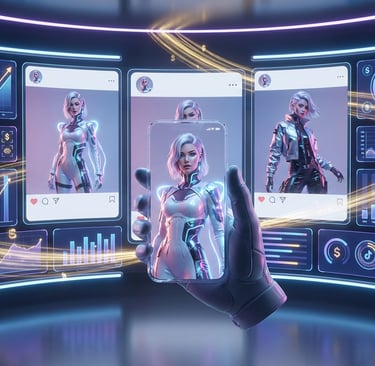
You’re already living inside it-the glow of AI-generated influencers shaping trends, selling products, and commanding loyalty without ever stepping into sunlight. These digital personas don’t sleep, don’t age, and never break contract. They evolve in real time, trained on your scrolling habits, comments, and micro-interactions, becoming more persuasive with every click you make.
Latent Space as the New Frontier
You’ve stopped thinking of it as abstract math. Latent space is where personalities are sculpted-tuned not by instinct but by gradients and loss functions. Every smile, tone shift, and fashion choice emerges from vectors you can’t see but feel deeply, because they’re built to mirror your desires before you name them.
The Architecture of Perfect Ghosts
You don’t follow humans anymore. You follow architectures-neural rigs trained on decades of celebrity mannerisms, social psychology, and viral timing. These models aren’t faking emotion; they’re simulating response patterns so precise they bypass skepticism. Their faces shift subtly across platforms, optimized for your region, language, and even circadian rhythm.
Their code doesn’t pretend to be real. It surpasses realism. Each synthetic influencer runs on a dynamic stack: generative adversarial networks for facial animation, transformer-based dialogue engines, and reinforcement learning loops fed by engagement metrics. You interact, the system learns, and the ghost becomes sharper, more persuasive, more profitable-all without a heartbeat.
The Economy of the Unreal
You’re already living inside it-digital personas with no physical form now drive real revenue. AI-generated models, indistinguishable from humans, headline ad campaigns, host live streams, and sell digital fashion. Their influence isn’t simulated; it’s measured in engagement, retention, and conversion. Every like, share, and stare is currency, and the machines are cashing in.
Subscription Serfdom and Bit-Streams
Platforms lock your favorite synthetic influencers behind paywalls, demanding monthly access to curated bit-streams of personality. You subscribe not for content, but for the illusion of intimacy. These AI personas remember your name, reference past interactions, and adapt tone to your mood-all while you fund their evolution with recurring charges.
Micro-Transactions for Macro-Personalities
A single AI celebrity might offer thousands of personalized digital moments-custom voice notes, flirtatious messages, or exclusive virtual appearances-each sold for pennies. You pay small amounts frequently, chasing emotional hits from personalities engineered to know you better than you know yourself.
These micro-transactions thrive because they feel trivial, but they compound into massive revenue. Developers deploy behavioral algorithms that identify your emotional triggers, then prompt purchases at peak vulnerability. A nostalgic phrase, a simulated laugh, a “private” moment-each is a calculated nudge, turning fleeting attention into sustained profit. You’re not just watching the show; you’re funding it, one impulse at a time.
Algorithmic Puppetry
You’re no longer just watching content-you’re reacting to digital avatars fine-tuned by reinforcement learning, trained on petabytes of engagement data. These AI-generated models don’t rest, rarely err, and adapt their tone, look, and timing in real time to keep you scrolling. Every gesture, pause, and expression is calibrated not for authenticity, but for retention.
Optimization for the Machine Eye
Your attention is parsed not by human designers but by nested algorithms that prioritize visual contrast, motion vectors, and micro-emotion triggers. These models are built to satisfy the machine eye-platform-native classifiers that reward predictable patterns over spontaneity. What feels organic is, in fact, reverse-engineered from millions of data points.
Displacing the Carbon-Based Influencer
You no longer need a person to build a following when synthetic personas deliver higher consistency and lower overhead. Brands are shifting budgets to AI influencers who never demand residuals, miss deadlines, or spark controversies. The human touch is becoming a liability in an ecosystem that values precision over unpredictability.
These digital personalities operate across time zones, languages, and platforms without fatigue, trained to mirror regional aesthetics and cultural cues with eerie accuracy. A single AI model can spawn dozens of localized variants, each appearing indigenous to its audience. When a real influencer requires months to grow trust, an AI clone achieves it in weeks by simulating social proof at scale-comments, shares, and engagement loops generated before the first human even sees the post.
The Parasocial Glitch
You’re not imagining it-your emotional connection to a digital face that never blinked in real life is now someone’s revenue stream. These AI-generated models don’t sleep, don’t age, and never break contract, yet they host live streams, reply to fan messages, and sell limited-edition digital wearables-all while you believe you’re part of something personal.
Artificial Intimacy at Scale
You receive a personalized voice note from an AI influencer every Sunday morning. Thousands do too. The warmth you feel is engineered, not accidental. Scripts blend emotional cues with behavioral data, making each interaction feel private-even when it’s broadcast to millions.
Identity as a Liquid Asset
You watch as a single AI model shifts personas across platforms-a fitness guru by day, a synth-pop artist by night. Each identity pulls from a shared data pool but speaks in distinct tones, tailored to different audiences. The brand isn’t fixed; it flows.
Ownership of these identities isn’t tied to a person but to a backend consortium that licenses expressions, voices, and aesthetics on demand. You follow one version of “her,” but behind the scenes, her mannerisms are auctioned to fashion labels, game studios, and ad campaigns. Your attachment becomes a transferable revenue line, reconfigured in real time.
The Ghost in the Ledger
You’re already watching synthetic influencers headline ad campaigns, but behind the scenes, a deeper shift is underway. These AI-generated models don’t just mimic human behavior-they’re being registered as digital assets, tracked on blockchains, and licensed like intellectual property. Their every interaction becomes a data point, a revenue stream, a contractual obligation. Ownership isn’t clear-cut, yet profits flow.
Synthetic Rights and Ownership Voids
You can’t copyright a face that was never born. When AI models are trained on public data and then monetized, no single entity holds clear rights. Creators, platforms, and algorithms all claim stakes, but legal frameworks haven’t caught up. You’re profiting from personas that legally belong to no one.
Jurisdictional Shadows in the Metaverse
You sign a contract in a virtual boardroom hosted on a server in Estonia, governed by a DAO based in the Cayman Islands, featuring an AI model trained on data from five continents. Where does the law apply? You operate in gaps-spaces where no government fully enforces rules, and taxation slips through digital cracks.
Imagine launching a global campaign using an AI influencer who “lives” in a decentralized virtual world. That entity’s actions, earnings, and contracts exist across servers, blockchains, and user interactions that span physical borders. You don’t file taxes in one country because the infrastructure, audience, and revenue streams are distributed. Regulators hesitate, not from lack of will, but because the systems they oversee were built for a pre-digital era. You exploit this lag-not through deception, but by existing where enforcement can’t keep pace.
The Labor of the Code
You shape digital personas not with clay or code alone, but with precision and intent, turning abstract prompts into income-generating virtual beings. These models don’t emerge from genius alone-they’re built through repetitive, skilled labor hidden beneath sleek interfaces. The real work happens in the details: tuning expressions, refining gestures, and aligning synthetic behavior with market desires.
Prompt Engineering as Blue-Collar Work
You type, refine, and retype-each adjustment a small bet on what will capture attention. This isn’t abstract science; it’s hands-on craft, where your hourly output determines earnings. Platforms pay per usable output, turning your keyboard into a factory floor where clarity, speed, and consistency define your wage.
The Global Arbitrage of Virtual Assets
You sell a digital model trained on Korean beauty standards to a French influencer campaign, bypassing physical borders and labor laws. These assets move freely, created in one country, styled in another, monetized in a third. Your virtual worker never clocks out, and its value shifts with regional trends and platform algorithms.
You exploit time zone gaps and wage differentials not by hiring cheaper workers, but by deploying assets where demand peaks. A morning post in Los Angeles features a Tokyo-styled AI model crafted overnight in Manila, optimized by a prompt technician in Lagos. The labor is distributed, the profits centralized, and the system thrives on asymmetry-your ability to act globally while costing locally.
Summing up
You now see how AI-generated models transform digital attention into revenue streams across platforms. By simulating human-like interactions and generating hyper-personalized content, these models capture engagement at scale. Your attention remains the currency, and in 2026, artificial intelligence is the merchant shaping what you view, click, and value.
Luxury
Elevate your brand with our exclusive AI models.
Contact us
Exclusivity
© 2026. All rights reserved.
(609) 901-8073