From Prompt to Collection: The Rise of AI-Generated Fashion Design
3/18/20264 min read
For over a century, the fashion design process has followed a familiar rhythm: a designer finds inspiration in a vintage photograph, a piece of architecture, or a natural landscape. They sketch, they drape fabric on a mannequin, they iterate through dozens of physical samples. It is a beautiful, tactile, but notoriously slow and wasteful process.
In 2026, that rhythm is being disrupted by a new collaborator: Generative AI. We are entering the era of "Prompt-to-Collection," where the boundary between human creativity and machine intelligence is becoming increasingly blurred. AI is no longer just a tool for organization; it is becoming a core part of the creative ideation process.
The New Creative Workflow: Ideation at the Speed of Thought
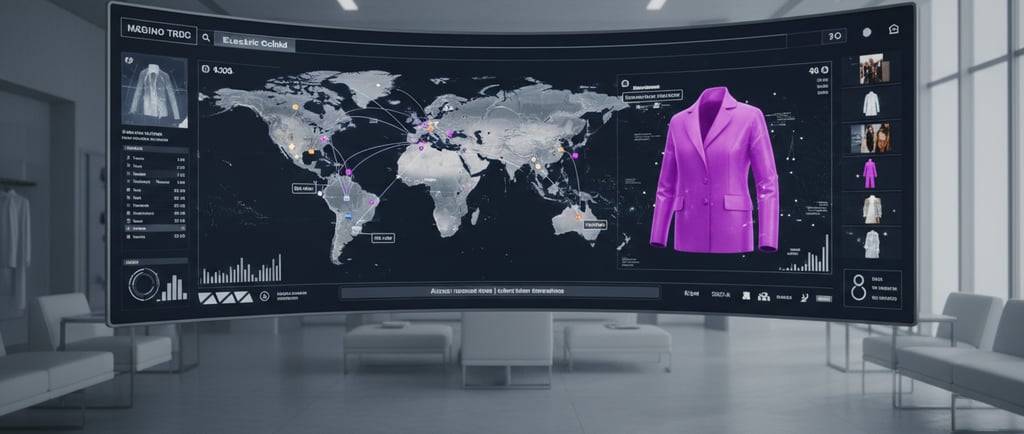
The most significant impact of AI in fashion design is at the very beginning of the creative cycle. Traditionally, a designer might spend weeks creating a mood board. Today, they can use AI to generate hundreds of high-fidelity "concept garments" in minutes. By inputting prompts like "A structured blazer inspired by 1950s brutalist architecture, rendered in a translucent bio-synthetic silk with iridescent highlights," a designer can instantly see a visual representation of their idea.
This isn't about the AI "replacing" the designer. Instead, it acts as a "super-powered mood board." It allows designers to explore "what if" scenarios that would be too expensive or time-consuming to prototype physically. It pushes the boundaries of what is possible, suggesting silhouettes and material combinations that a human mind might not have intuitively reached.
Trend Forecasting: From Guesswork to Data Science
Historically, trend forecasting was a mix of intuition, travel, and "gut feeling." Forecasters would look at what was happening in the underground clubs of Berlin or the street style of Tokyo and predict what would hit the mass market in two years.
AI has turned this into a high-precision science. By analyzing millions of images from social media, runway shows, and e-commerce data in real-time, AI can identify "micro-trends" as they emerge. It can predict not just what will be popular, but when and where. For a brand, this means the difference between a sold-out collection and a warehouse full of unsold inventory. AI-driven forecasting allows for "just-in-time" design, where collections are created in response to real-time cultural shifts rather than arbitrary seasonal calendars.
Generative Pattern Making and 3D Prototyping
The "magic" of AI design isn't just in the pretty pictures; it’s in the technical execution. Once a concept is approved, AI can assist in the "boring" but essential parts of design: pattern making and grading.
Advanced AI tools can now take a 2D sketch and automatically generate the 3D patterns required to manufacture it. It can simulate how a specific fabric—say, a heavy wool versus a light chiffon—will drape and move on a body. This "digital twin" of the garment allows for virtual fit-testing, reducing the need for multiple physical samples. In an industry where a single sample can cost thousands of dollars and take weeks to produce, the efficiency gains are transformative.
The "Prompt Engineer" as the New Creative Director
As AI becomes more integrated into the design studio, the role of the Creative Director is evolving. We are seeing the rise of the "Design Architect"—someone who doesn't just draw, but who understands how to "curate" the output of an AI. The skill is no longer just in the hand-eye coordination of sketching, but in the ability to craft the perfect "prompt" and then refine the machine's output into a cohesive, brand-aligned collection.
This shift is democratizing fashion design. Talented individuals who may not have had formal training in technical drawing or pattern making can now bring their visions to life using AI. We are seeing a surge of "AI-native" fashion brands that exist entirely in the digital space before a single stitch is ever sewn.
The Ethics of Inspiration vs. Imitation
Of course, the rise of AI-generated design brings significant ethical and legal challenges. If an AI is trained on the archives of legendary designers like Alexander McQueen or Vivienne Westwood, who owns the resulting "new" designs? The industry is currently in a heated debate over "style copyright."
Brands must be careful to use AI as a tool for original creation rather than a machine for sophisticated imitation. The most successful designers in 2026 are those who use AI to augment their unique "human" perspective, ensuring that the final product still carries the soul and intentionality of a human creator.
The Future: Generative, Sustainable, and Personalized
The ultimate goal of AI-generated design is a "circular" fashion economy. By using AI to predict trends accurately, design for zero-waste patterns, and create only what is needed, the industry can finally address its massive overproduction problem.
In the near future, we may see "Generative Retail," where a customer can go to a brand's website and "co-design" their own garment. You start with a brand's signature silhouette, use an AI slider to adjust the sleeve length or the print, and the AI generates the custom manufacturing files instantly. This is the future of fashion: a perfect blend of human artistry, machine intelligence, and sustainable production.
Frequently Asked Questions
Can AI actually "design" a wearable garment? Yes. While early AI tools only generated "flat" images, modern 2026 design platforms are integrated with 3D CAD software. They generate the actual technical patterns and "tech packs" that factories need to cut and sew a physical garment.
Does AI-generated fashion look "robotic"? Quite the opposite. Because AI can analyze millions of organic textures and historical references, it often produces designs that are more complex and "avant-garde" than traditional human-led designs. The "robotic" look is a choice, not a limitation.
Is AI design putting human designers out of work? It is changing the nature of their work. Designers who spend all their time on repetitive technical tasks are at risk. However, designers who embrace AI as a "creative partner" are finding they can produce more work, of higher quality, in less time than ever before.
Luxury
Elevate your brand with our exclusive AI models.
Contact us
Exclusivity
© 2026. All rights reserved.
(609) 901-8073