
From Runway to Weights: How Fashion Data Is Reshaping AI Model Training
1/21/20265 min read
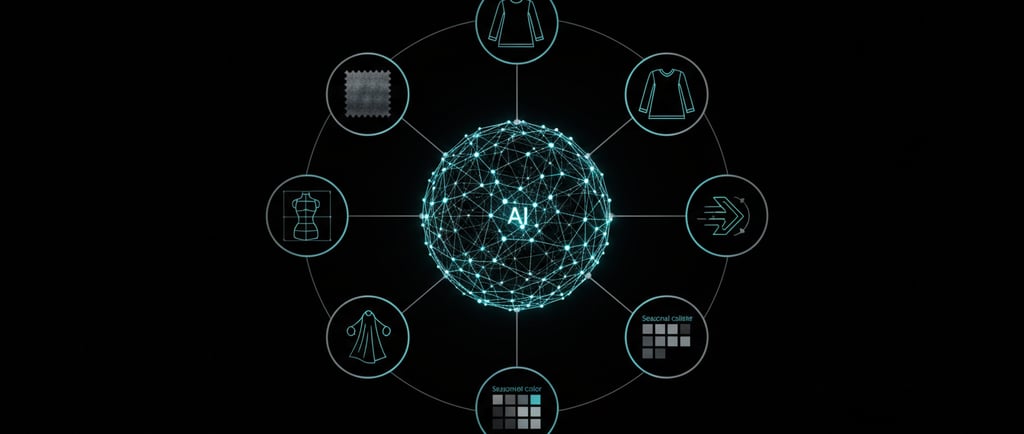
For years, AI models were trained on the same broad datasets: ImageNet, LAION, Common Crawl, Wikipedia, YouTube transcripts. These datasets taught models to recognize objects, understand language, and generate plausible images—but they were never designed to understand fashion as a discipline.
Fashion isn't just "images of clothing." It's a complex, structured domain with its own physics, semantics, temporality, and cultural logic. Garments have construction rules. Fabrics behave in specific ways. Silhouettes evolve seasonally. Trends ripple through markets in predictable cycles. Body–garment interaction follows biomechanics and material science.
None of that nuance exists in general-purpose datasets.
As fashion brands and AI labs realize this gap, a new category of training data is emerging: fashion-specific datasets that capture silhouettes, draping, movement, seasonal cycles, fabric properties, and garment construction—not as metadata, but as core training signals.
This shift is reshaping how AI models are built, labeled, and deployed in fashion. It's also creating a new competitive moat: the brands and labs with the best fashion data will train the best fashion models—and those models will define the next generation of design tools, virtual try-on, trend forecasting, and content generation.
This article explores:
what makes fashion data fundamentally different,
how it's collected and labeled,
how it influences model architecture and training,
and why fashion datasets are becoming strategic IP.
What Makes Fashion Data Different from General Image Data
General image datasets treat clothing as objects in scenes. Fashion datasets treat garments as structured, dynamic, material systems.
Here's the difference:
General image dataset annotation:
"woman"
"dress"
"standing"
"indoors"
Fashion-specific dataset annotation:
garment type: midi dress
silhouette: A-line
neckline: V-neck
sleeve: three-quarter, bishop
fabric: silk charmeuse
drape quality: fluid, bias-cut
movement state: static pose
fit: relaxed through bodice, fitted at waist
construction: princess seams, invisible zipper
trend context: spring 2024, romantic minimalism
body interaction: fabric pools at hip, slight tension at shoulder
That depth of annotation is what allows a model to understand fashion, not just recognize it.
The Core Dimensions of Fashion Data (What Models Need to Learn)
Fashion-trained models require data across multiple specialized dimensions:
1) Silhouette and Shape Language
Fashion is a language of shapes. Silhouettes communicate:
era
formality
brand identity
body emphasis
Datasets need to capture:
garment outlines across angles
how silhouettes change with movement
how layering affects overall shape
how proportions shift across sizes
This is why fashion datasets often include segmentation masks and pose-aligned silhouette traces—not just bounding boxes.
2) Fabric Physics: Drape, Stretch, Tension, Flow
Fabric isn't static. It:
drapes under gravity
stretches with body movement
creates tension at seams and closures
flows and billows in motion
Training data must capture:
fabric in motion (video or multi-frame sequences)
close-ups of fabric behavior at stress points
different fabrics on the same garment type
fabric interaction with skin and undergarments
This is especially critical for lingerie, swim, and activewear—categories where fabric performance is the product.
3) Garment Construction and Seam Logic
A garment isn't a texture—it's an engineered object with:
seams
darts
pleats
gathers
closures
trim
hardware
Fashion datasets increasingly include:
technical flat sketches
construction diagrams
seam placement annotations
fabric grain direction
pattern piece relationships
This helps models learn what's physically possible vs. what's a hallucination.
4) Seasonal and Trend Cycles
Fashion is temporal. Trends:
emerge
peak
decline
resurface
Datasets that include time-stamped runway images, editorial archives, and sell-through data allow models to learn:
what's "in" vs. "out"
how trends diffuse from runway to street
regional and demographic trend variation
cyclical vs. linear trend patterns
This is the foundation of AI-powered trend forecasting.
5) Body–Garment Interaction
How a garment sits on a body is biomechanics + material science:
strap tension
waistband grip
fabric indentation
edge roll
movement restriction or flow
Datasets that capture this require:
multi-angle body scans
garments on diverse body types
movement sequences (walking, sitting, reaching)
pressure mapping (where fabric pulls or compresses)
This is what separates "fashion illustration AI" from "fit-accurate virtual try-on AI."
6) Multimodal Pairing: Image + Text + Metadata
Fashion is inherently multimodal. A single garment has:
visual appearance
material properties (text)
construction specs (structured data)
styling context (text + image)
customer sentiment (reviews, returns)
Training models on aligned multimodal data allows them to:
generate garments from text descriptions
describe garments in technical language
predict fit issues from images
recommend styling based on occasion
How Fashion Datasets Are Built (the hard part)
Creating fashion-specific datasets is expensive and labor-intensive—but it's becoming a competitive necessity.
1) Runway and Editorial Scraping (with curation)
Many datasets start with:
runway archives (Vogue Runway, Style.com archives)
editorial shoots (magazine digitization)
brand lookbooks
But raw scraping isn't enough. You need:
deduplication
quality filtering
rights clearance (or synthetic re-creation)
metadata enrichment
2) Ecommerce Catalog Mining
Ecommerce sites are goldmines of structured fashion data:
product images (multiple angles)
descriptions (fabric, fit, care)
size charts
customer reviews
return reasons
Brands with large catalogs can use their own data as proprietary training sets—a huge advantage.
3) 3D Garment Simulation
Increasingly, fashion datasets include synthetic data from 3D garment simulators:
CLO3D
Marvelous Designer
Browzwear
These tools can generate:
garments on diverse body types
fabric drape variations
movement sequences
construction-accurate renders
Synthetic data solves:
diversity gaps
rare garment types
controlled variation (same garment, different fabrics)
4) Video and Motion Capture
Static images can't teach fabric flow. Video datasets capture:
runway walks
model movement
fabric in wind or motion
garment behavior during activity
Motion-capture datasets (often from activewear or VFX studios) provide:
body pose sequences
garment deformation over time
physics-grounded training signals
5) Expert Annotation (the bottleneck)
Fashion annotation requires domain expertise:
identifying fabric types
labeling construction details
assessing fit quality
recognizing trend context
This is why fashion datasets are expensive. You can't outsource annotation to general crowdworkers—you need trained fashion professionals or highly structured labeling workflows.
How Fashion Data Changes Model Architecture and Training
Fashion-specific data doesn't just improve existing models—it drives architectural innovation.
1) Multimodal Encoders for Fabric + Shape + Text
Fashion models increasingly use separate encoders for:
visual appearance
fabric texture
garment structure
text descriptions
These encoders are trained jointly so the model learns:
"silk" (text) ↔ specular highlights (image)
"A-line" (text) ↔ silhouette shape (image)
"bias-cut" (text) ↔ diagonal drape (image)
2) Temporal Modeling for Trend Prediction
Trend forecasting models use time-series architectures:
transformers with positional time encoding
recurrent layers for seasonal cycles
attention over historical trend data
These models learn:
what follows what
how long trends last
when revivals happen
3) Physics-Informed Layers for Fabric Simulation
Some fashion models incorporate physics priors:
gravity
tension
elasticity
collision
This helps models generate:
realistic drape
plausible stretch
accurate layering
4) Hierarchical Representations (Garment → Outfit → Collection)
Fashion has natural hierarchies:
garment
outfit
collection
seasonal line
Models trained on hierarchical fashion data learn:
how pieces coordinate
how collections cohere
how brands maintain identity across seasons
Why Fashion Data Is Becoming Strategic IP
In the past, fashion IP was:
designs
patterns
brand identity
customer lists
Now, fashion datasets are joining that list.
Here's why:
1) Data moats are defensible
If you have:
10 years of runway archives
100,000 SKUs with fit data
customer reviews and return reasons
proprietary 3D garment simulations
…you can train models competitors can't replicate.
2) Data compounds
Every new collection adds training data. Every customer interaction refines the model. Fashion data gets more valuable over time.
3) Data enables vertical integration
Brands with strong datasets can:
design with AI
forecast trends
generate content
personalize recommendations
optimize inventory
All without relying on third-party AI vendors.
How Noir Starr is Keeping Up
For Noir Starr Models, fashion data isn't just about "better images." It's about:
Consistency: training models on your aesthetic so every output feels like Noir Starr
Realism: using garment construction data so lingerie looks structurally correct
Diversity: using body-diverse datasets so your virtual models represent real customers
Speed: using annotated pose/lighting libraries so you can generate catalog-scale content in hours
The brands that win in AI-powered fashion won't be the ones with the best prompts.
They'll be the ones with the best data pipelines.
Luxury
Elevate your brand with our exclusive AI models.
Contact us
Exclusivity
© 2026. All rights reserved.
(609) 901-8073