
How AI Is Rewriting Fashion Trend Forecasting Before the Runway Even Starts
Anthony Starr
4/6/20263 min read
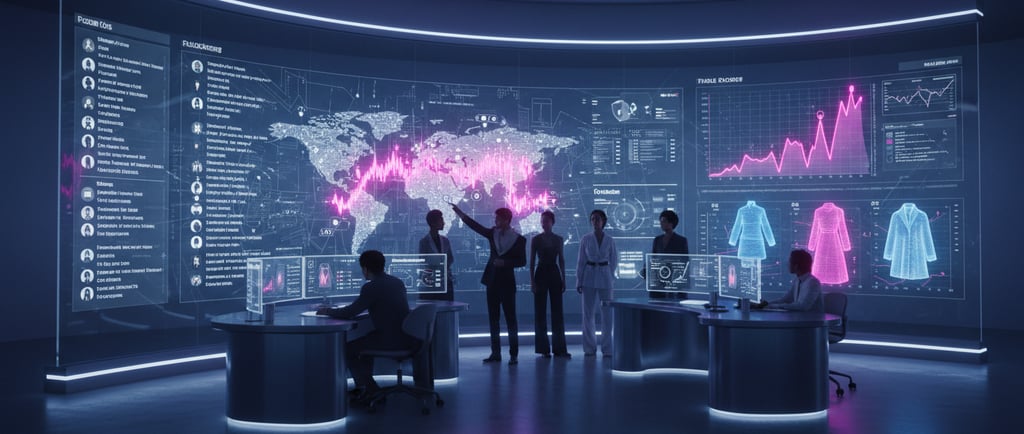

For decades, fashion trend forecasting has been a mix of intuition, cultural immersion, and educated guesswork. Designers and forecasters traveled the world, studied street style, attended underground events, and tried to predict what consumers would want six months—or even a year—into the future.
But in 2026, that entire system is being rewritten.
Artificial Intelligence is transforming trend forecasting from an art into a science. Instead of waiting for trends to emerge on the runway, brands can now predict them before a single model steps onto the catwalk. The result is faster production cycles, more accurate collections, and a fundamental shift in how fashion responds to culture.
From Intuition to Data-Driven Prediction
Traditional forecasting relied heavily on human interpretation. Agencies like WGSN or Trend Union built their reputations on identifying patterns early—but even the best forecasts were still predictions based on limited data.
AI changes the scale completely.
Today’s AI systems analyze:
Millions of social media posts (TikTok, Instagram, Pinterest)
Real-time search trends
E-commerce behavior (clicks, wishlists, carts)
Street style imagery from global cities
Cultural signals like music, film, and events
Instead of a seasonal report, brands now get live trend dashboards.
For example, an AI might detect that a specific shade—like Electric Orchid—is appearing more frequently across influencers in Seoul, Berlin, and Los Angeles simultaneously. Within days, it flags this as an emerging global color trend, long before it hits mainstream awareness.
Micro-Trends: The New Currency of Fashion
One of the biggest shifts AI enables is the rise of micro-trends.
In the past, trends were broad and seasonal:
“Fall = earth tones”
“Spring = florals”
Now, trends are hyper-specific and fast-moving:
A cropped metallic bomber inspired by K-pop visuals
Sheer layering styles from niche TikTok communities
Neo-minimal tailoring influenced by Scandinavian creators
AI identifies these micro-trends early and tracks their velocity.
More importantly, it predicts:
Whether a trend will scale globally
How long it will last
Which demographics will adopt it
This allows brands to avoid investing in trends that will fade in weeks—and double down on those with real staying power.
Predicting Before the Runway
Traditionally, runway shows were the starting point of trends.
Now, they’re often the confirmation.
Designers are increasingly using AI insights before creating collections. Instead of asking, “What do I want to design?” they’re asking, “What is the world already moving toward?”
This doesn’t mean creativity disappears—it becomes more strategic.
A designer might see:
Rising interest in structured silhouettes
Increased engagement with sustainable fabrics
A color trend accelerating in multiple regions
They can then interpret these signals through their own creative lens.
In many cases, runway collections now reflect trends that AI identified months earlier.
Speed to Market: The Competitive Advantage
In the era of TikTok virality, timing is everything.
A trend can explode globally in 72 hours—and disappear just as fast.
AI forecasting allows brands to:
Detect trends early
Design and prototype faster
Launch products while demand is peaking
This is especially critical for:
Fast fashion brands
DTC startups
Digital-first fashion houses
The brands that win are no longer the ones with the best designers—they’re the ones with the fastest feedback loops.
The Feedback Loop: Real-Time Learning
AI doesn’t just predict trends—it learns from outcomes.
Every product launch becomes data:
Did it sell out?
Was it returned?
Did engagement match predictions?
This creates a closed feedback loop where forecasting continuously improves.
Over time, AI becomes more accurate than any human forecaster because it:
Processes more data
Updates in real-time
Learns from every success and failure
This is why many brands now treat AI not as a tool—but as a core decision-maker.
The Risk: Homogenization of Style
There’s a downside to hyper-accurate forecasting.
If every brand uses similar AI tools, they may all chase the same trends.
This can lead to:
Over-saturation of identical styles
Loss of brand identity
“Algorithmic fashion” that feels repetitive
The challenge is balance.
The most successful brands use AI for insight, not imitation.
They combine data with a distinct creative voice.
AI tells you what’s trending.
Humans decide what’s meaningful.
The Future: Predictive Culture, Not Reactive Fashion
We’re moving from reactive fashion to predictive culture.
In the near future:
Trends will be identified before they go viral
Collections will be designed in real-time
Production will align instantly with demand
Eventually, consumers themselves will influence trends directly through their behavior—feeding AI systems that shape what gets created next.
Fashion becomes a continuous loop: Culture → Data → AI → Design → Culture
Conclusion
AI is not replacing trend forecasting—it’s redefining it.
The runway is no longer the starting point of fashion. It’s just one signal in a much larger, data-driven ecosystem.
The brands that thrive in this new era will be those that:
Embrace AI without losing creativity
Move fast without losing identity
Use data to enhance—not replace—human vision
Because in the end, fashion isn’t just about predicting what people will wear.
It’s about understanding why they want to wear it—and getting there first.
FAQs
Is AI trend forecasting accurate?
Yes—especially at scale. While not perfect, AI significantly outperforms traditional methods by analyzing real-time global data.
Does this mean trends will move faster?
Absolutely. AI accelerates the entire cycle, from discovery to production to saturation.
Will designers become obsolete?
No. Designers are evolving into “editors of AI output,” combining data insights with human creativity and storytelling.
Luxury
Elevate your brand with our exclusive AI models.
Contact us
Exclusivity
© 2026. All rights reserved.
(609) 901-8073