
Inside the Synthetic Creator Economy
Who Really Profits From AI Models?
Anthony Starr
4/15/20267 min read
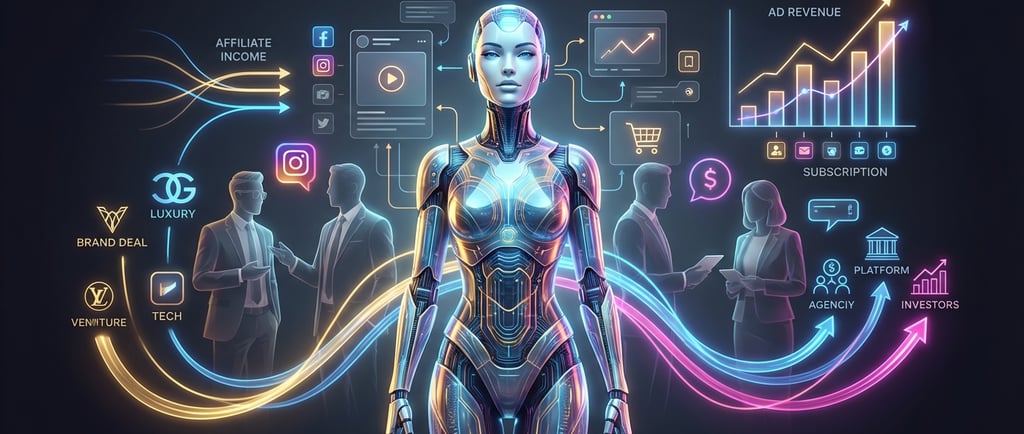
Synthetic content is reshaping how media is made, distributed, and monetized. You interact with AI-generated text, images, and voices daily, often without knowing it. The real financial gains, however, flow to a small group of tech companies and investors who control the models, not the creators whose work trains them. You’re part of this system-whether you realize it or not.
The Silicon Mirage: Crafting the Perfect Non-Human
The Illusion of Autonomy
You see the byline and assume a person wrote it. A name like "Elena Chen" or "Marcus Reed" appears beneath a polished article, complete with a headshot and bio. What you don’t see is the server farm in Oregon where a language model trained on billions of scraped texts generated that content in under three seconds. These synthetic creators are designed to mimic human authorship so precisely that even seasoned editors struggle to tell the difference. Their voices are calibrated to sound informed, empathetic, even witty-carefully avoiding the stilted tone once associated with machines.
Manufactured Authenticity
Platforms now deploy AI influencers with curated Instagram feeds, TikTok dances, and podcast appearances-all without a single living being behind the profile. Their personalities are stitched together from trending behaviors, popular opinions, and emotional cues mined from real human interactions. You follow them not because they’re real, but because they’ve been engineered to feel real. The algorithms learn which expressions of vulnerability or humor generate the most engagement, then replicate them with eerie precision. There’s no off-camera moment, no bad day, no unplanned deviation-just an endless loop of optimized relatability.
The Labor Behind the Mask
Behind every flawless synthetic persona are dozens of underpaid data annotators, prompt engineers, and content moderators ensuring the illusion holds. You rarely hear their names or see their faces, but their labor is what smooths the edges of machine-generated text, corrects biased outputs, and fine-tunes emotional tone. These workers operate in global hubs where labor laws are lax and oversight is minimal. Their job is to make the non-human appear convincingly human, all while being paid a fraction of what the AI-generated content earns for its owners.
Profit Without Personhood
Companies claim these synthetic creators are the future of scalable content-efficient, consistent, and always on-brand. What they don’t advertise is how this model shifts value away from human creators and into proprietary systems controlled by a handful of tech firms. You may engage with the AI poet, subscribe to the AI news digest, or buy products endorsed by a digital influencer, but none of that revenue flows back to the people whose words, styles, and lives trained the model in the first place. The profit flows upward, while the illusion of creativity flows outward, endlessly replicating itself.
The Invisible Puppeteers: Who Holds the Strings?
The Data Harvest
You leave traces every time you post, comment, or upload. Those fragments-your words, your style, your rhythm-are collected long before you ever hear about synthetic creators. Platforms quietly archive years of user-generated content, turning casual expression into training fuel. No consent forms appear when your tweet becomes part of a model’s vocabulary. The data isn’t stolen in the traditional sense, but it’s taken just the same-repurposed without compensation or credit.
Corporate Architects
Behind every AI-generated influencer is a tech company with infrastructure, capital, and legal teams. These entities decide which voices get replicated, which aesthetics get amplified, and which synthetic personas receive marketing budgets. You don’t see their logos on viral posts, but their fingerprints are everywhere. They own the servers, the algorithms, and the distribution channels-meaning they control both creation and visibility.
The Licensing Mirage
Some platforms claim to offer opt-in programs for creators, promising royalties if their style is used. In practice, these systems are buried in settings, poorly explained, and rarely result in meaningful payouts. Even when you agree, the terms often grant indefinite, irrevocable rights. Your digital likeness could be licensed to third parties you’ll never know about, generating revenue streams you won’t access.
Investor Priorities
Startups building synthetic creators are not primarily interested in art or expression. Their pitch decks focus on scalability, engagement rates, and cost efficiency. Human creators burn out; AI profiles don’t. Investors want predictable outputs, 24/7 availability, and minimal overhead. You’re seen as a template, not a collaborator. The goal isn’t to mirror you-it’s to replace what you do at a fraction of the cost.
Regulatory Gaps
No current law clearly protects your voice, writing style, or online persona from being cloned. Copyright doesn’t cover mannerisms or tone. Trademark law only applies if you’ve branded your identity formally. Most creators operate without legal shields, unaware their digital footprint is already in training datasets. By the time legislation catches up, the models will have evolved beyond recognition.
The Digital Gold Rush: Monetizing the Void
The Illusion of Ownership
You don’t actually own the AI-generated influencer you spent months training and promoting. That hyperreal face with millions of followers? It’s built on data you didn’t create, models you didn’t train, and infrastructure you don’t control. The platforms hosting your synthetic avatar retain ultimate authority-modifying terms, throttling reach, or shutting down accounts without warning. What feels like entrepreneurship is often just tenancy in someone else’s digital empire.
Revenue Streams Built on Sand
Ad revenue, brand deals, and NFT drops may flood your dashboard, but most of those earnings evaporate before they reach sustainable ground. Platforms take 30% or more. Licensing fees for voice and image synthesis eat into margins. Payment processors flag AI-driven accounts as high-risk, freezing funds on suspicion of fraud. You’re chasing metrics engineered to keep you producing, not profiting-engagement over equity, visibility over value.
The Hidden Tax of Attention
Every post, every interaction, every algorithmic nudge is designed to extract more from you. The synthetic creator economy runs on borrowed attention-yours and your audience’s. You train models with real emotional labor while the system learns how to replace you. The more convincing your AI persona becomes, the more the market devalues the human behind it. Profit isn’t in authenticity; it’s in automation, and you’re just the prototype.
Who Controls the Tools?
Open-source models promise freedom, but the real power sits with those who fund, host, and scale them. Cloud providers set the prices. API limits dictate your output. A single policy change can collapse an entire synthetic brand overnight. You’re not building a business-you’re stress-testing someone else’s infrastructure. The tools you rely on are not neutral; they’re commercial products designed to monetize your dependency.
Ethical Decay in the Prompt Box
The Illusion of Neutrality
You’ve likely been told that AI models are neutral tools-blank slates shaped only by the prompts you feed them. This idea is comforting, but dangerously misleading. Every model carries the weight of its training data, which includes copyrighted books, scraped articles, and personal content pulled from the web without consent. When you type a prompt asking for a “blog post in the style of Joan Didion,” the system doesn’t conjure voice from thin air. It reassembles fragments of real writers’ labor, repackaged and resold as novelty. You’re not engaging a muse; you’re interacting with a mirror polished by exploitation.
Consent as an Afterthought
Most creators whose work fuels these models never agreed to be part of the dataset. Their writing, art, or voice appears in outputs not because they licensed it, but because it was taken. You might not think twice when generating a poem “inspired by” a living poet, but that poet didn’t sign a contract with the AI company. Their style is being mimicked, their audience potentially diverted, and their livelihood undermined-all while the platform profits from API calls and subscription tiers. The absence of consent isn’t a technical oversight; it’s baked into the business model.
The Erosion of Attribution
There’s no mechanism in most AI interfaces to trace where a generated phrase originated. You can’t click a button to see which author’s sentence structure was reverse-engineered into the output. This opacity benefits the companies selling access to the model, because transparency would force accountability. If users could see that a generated legal brief pulls verbatim from a law professor’s unpublished lecture notes, the ethical breach would be undeniable. Instead, the system treats all content as fair game, dissolving authorship into algorithmic noise.
Profit Flows Upward
The people who actually built the cultural foundation that AI imitates-writers, journalists, indie artists-see none of the revenue from prompt-based services. You pay a monthly fee to access a tool trained on their work, and the platform uses that income to scale infrastructure and enrich investors. The original creators are left with takedown requests, legal threats, or silence. This isn’t innovation. It’s extraction disguised as progress, where the cost of creation is socialized and the profits are privatized.
The Architecture of Deception
How Value Is Extracted Without Consent
You rarely see your name attached to the AI-generated content that mimics your voice, style, or creative patterns. Corporations harvest vast datasets from public posts, articles, and social media, training models on your work without permission or compensation. These systems learn to replicate your tone, structure, and even your quirks-then deploy them at scale. The output feels familiar because it was built from fragments of your labor, yet you receive no share of the revenue it generates.
The Illusion of Participation
Platforms encourage creators to “join the future” by submitting content for AI training, often buried in lengthy terms of service. You might think you’re contributing to innovation, but the fine print ensures your input becomes a permanent, royalty-free asset. Once ingested, your work fuels models that compete with you-offering synthetic versions of your craft at a fraction of the cost. The invitation to participate masks a one-sided transaction where your creativity subsidizes corporate profit.
Data as Unpaid Labor
Every caption, blog post, or video transcript you publish becomes raw material for machine learning algorithms. These models don’t just learn from your content-they absorb the cultural context, emotional nuance, and aesthetic choices that define your voice. No invoice is sent, no contract signed, yet your intellectual output is systematically repurposed. The infrastructure treats your digital footprint as a public utility, extracting value while leaving you disconnected from the economic returns.
The Hidden Cost of “Free” Tools
When AI writing assistants or image generators offer free access, the price isn’t monetary-it’s your data. Each prompt you enter, each edit you make, feeds back into the system to refine its performance. You’re not just a user; you’re a trainer, fine-tuning models with real-time feedback. The convenience comes at the cost of invisibly expanding proprietary datasets, reinforcing systems that will eventually undercut the very creators they claim to serve.
To wrap up
Following this exploration, you see that AI models generate immense value, yet most profits flow to tech companies and investors, not the creators or data contributors who fuel development. You are left questioning fairness in ownership and compensation, especially as synthetic content grows. The system rewards infrastructure, not originality.
Luxury
Elevate your brand with our exclusive AI models.
Contact us
Exclusivity
© 2026. All rights reserved.
(609) 901-8073