
Neural Retouching: Why AI Models are Eliminating the Post-Production Phase
3/9/20263 min read
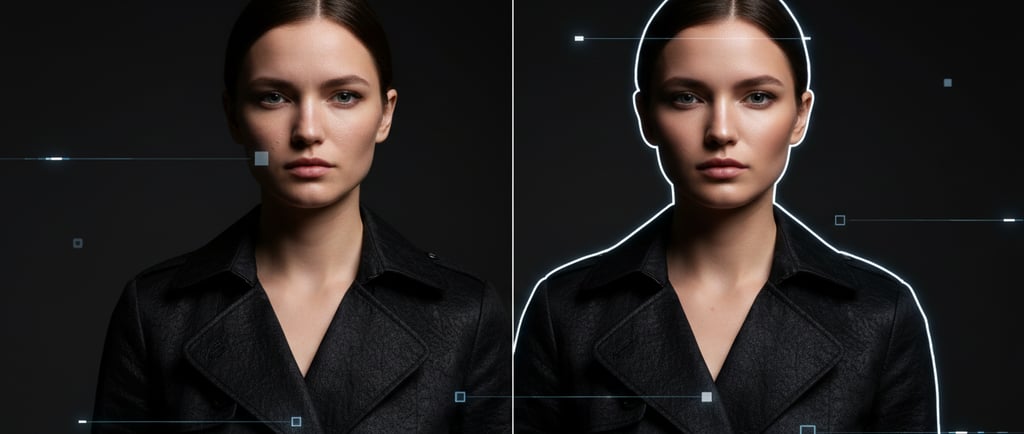
In the traditional fashion industry, the "click" of the camera shutter is only the beginning. A high-end editorial shoot can spend weeks in post-production, where elite retouchers painstakingly adjust skin texture, remove stray hairs, fix fabric wrinkles, and "paint" with light to create that signature luxury glow. But as of Feb 20, the AI fashion model industry is making this entire phase obsolete. We are entering the era of neural retouching.
This isn't just about "filters." It’s about end-to-end generation, where the AI model is trained to output a "final-frame" image that already includes the lighting, skin finish, and fabric perfection that used to require hundreds of hours of human labor. This update explores how "zero-post" workflows are disrupting the fashion economy and why the "retoucher" is being replaced by the "latent space architect."
The "Zero-Post" Workflow: From Prompt to Print
In a traditional workflow, the "raw" image is often flat and imperfect. In the Neural Retouching era, the AI doesn't just generate a person; it generates a finished masterpiece.
By using specialized "Refiner" models and "Lighting Adapters," platforms like Noir Starr can now produce images that are:
Pre-Lit: The AI understands "global illumination" and "subsurface scattering," meaning skin looks luminous and translucent from the first pixel.
Pre-Groomed: Every hair is perfectly placed, and every "flyaway" is handled by the model’s internal logic, not a clone stamp tool.
Pre-Pressed: Fabric wrinkles are either realistically preserved for "lifestyle" shots or mathematically smoothed for "e-commerce" shots, all based on the initial prompt.
This "zero-post" capability is the primary reason luxury brands are moving their budgets toward AI. It’s not just about the cost of the model; it’s about the elimination of the post-production bottleneck.
The "Latent Retoucher": A New Creative Role
The traditional retoucher isn't disappearing; they are evolving into the latent retoucher. Instead of using Photoshop to fix an image, they are using "ControlNets" and "IP-Adapters" to guide the AI’s generation process.
A latent retoucher doesn't "fix" a bad image; they prevent it. They adjust the "weights" of the skin-texture model or the "strength" of the lighting adapter before the image is even generated. If a brand wants a "dewy" skin finish for a summer campaign, the Latent Retoucher doesn't paint it on later—they bake it into the model’s "latent space" for that specific session.
"Skin-Truth" vs. "Neural Perfection"
One of the biggest debates on Feb 20 is the balance between "Skin-Truth" (realistic imperfections) and "Neural Perfection" (the hyper-real, poreless look).
High-end AI models now have "Imperfection Sliders." A brand can choose exactly how much "reality" they want:
Level 1: Hyper-real, "Vogue" cover finish (zero imperfections).
Level 3: Natural skin texture, visible pores, slight tonal variations.
Level 5: "Raw" aesthetic, including beauty marks, fine lines, and realistic skin "noise."
Because this is all handled by the AI’s neural network, the transition between these levels is seamless. You aren't "blurring" the skin; you are telling the AI to reimagine the skin with a different level of detail.
The Economic Disruption: Bankrupting the Post-House
For decades, high-end "post-houses" in London, New York, and Paris charged thousands of dollars per image for their retouching expertise. On Feb 20, these businesses are facing an existential threat.
When an AI model can generate a "finished" image in 30 seconds that is indistinguishable from a week’s worth of human retouching, the value proposition of the traditional post-house collapses. We are seeing a massive migration of talent, as the world’s best retouchers are being hired by AI platforms to help "train" the next generation of neural retouching models. They are teaching the AI their "secrets"—the specific ways they handle light and shadow—so the AI can do it automatically.
The "Authenticity" Label: Is it Retouched if it was Born Perfect?
This creates a fascinating legal and ethical loophole. Many countries now require brands to label images that have been "digitally altered" or "retouched." But if an AI model generates a "perfect" image from scratch, has it been "altered"?
Technically, there was no "original" image to alter. The image was born perfect. This is leading to a new wave of regulation discussions around "Synthetic Perfection" and whether AI-generated beauty needs its own set of disclosure rules, separate from traditional retouching.
Conclusion: The End of the Edit
On Feb 20, the AI fashion model industry is proving that the "edit" is no longer a separate phase of production—it is a feature of the generation.
By moving the retouching process into the "latent space," brands are achieving a level of speed, consistency, and quality that was previously impossible. In the world of neural retouching, the goal is no longer to "fix it in post." The goal is to generate it perfectly. For the fashion industry, this is the ultimate efficiency: the end of the edit and the beginning of the "Instant Masterpiece."
Luxury
Elevate your brand with our exclusive AI models.
Contact us
Exclusivity
© 2026. All rights reserved.
(609) 901-8073