Synthetic Seasonality: Training AI Models on the “Vibe” of Future Trends
3/4/20263 min read
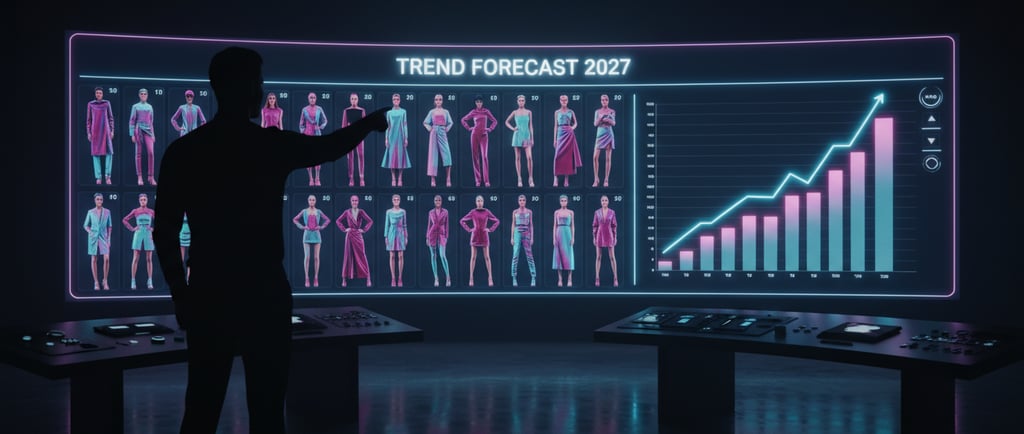
In the traditional fashion cycle, "seasonality" is a reactive process. Trends are spotted on the streets or the runways of Paris and Milan, and months later, brands scramble to produce collections and shoot campaigns that capture that specific "vibe." But in the AI fashion model industry, the clock is being rewritten. We are entering the era of synthetic seasonality—where AI models are being pre-trained on trends that haven't even happened yet.
By feeding predictive data—social sentiment, textile innovation reports, and macroeconomic shifts—into the "latent space" of AI models, brands are creating future-ready talent. These are digital twins and synthetic personas that already "know" how to wear the silhouettes of 2027, how to pose in the lighting of the next decade, and how to embody the "energy" of a season that is still years away.
This update explores how "trend-conditioned" AI is eliminating the lag between inspiration and execution and why the ability to "hallucinate" the future is the new competitive edge for luxury houses.
The Predictive Pivot: From Archival to Anticipatory
Most AI training is backward-looking. We train models on what has already been photographed. Synthetic seasonality flips this. Brands are now using "Trend Adapters"—modular AI layers that are fine-tuned on
Color Science Forecasts: The specific "Pantone" shifts predicted for the next 24 months.
Silhouette Projections: Data from 3D design software showing a shift from, for example, oversized streetwear to hyper-tailored futurism.
Cultural Sentiment: AI analysis of "vibe shifts" (e.g., a move from "quiet luxury" to "maximalist neon").
When these data points are injected into an AI model’s training, the model begins to generate outputs that feel "ahead of the curve." A brand can generate a full campaign for a 2027 collection today, using AI models that already "understand" the aesthetic language of that future moment.
"Vibe-Locking": Ensuring Brand Relevance in a Fast-Moving Market
The biggest risk for a fashion brand is being "late." If a trend peaks and you don't have the visual assets to meet it, you lose the market. Synthetic seasonality allows for "vibe-locking."
A brand like Noir Starr can create a "trend-locked" version of their digital talent. This version of the model is restricted to only generate assets that fit a specific future trend. This ensures that even if a brand has multiple teams working across the globe, every piece of content they produce will be perfectly aligned with the "future vibe" they’ve committed to.
This is particularly powerful for fast-to-market luxury. Brands can now test "future looks" on social media using AI models before they even commit to manufacturing the physical garments. If the "Synthetic Seasonality" test gets high engagement, they greenlight the production. If not, they pivot—all without a single physical sample being made.
The "Time-Travel" Campaign: Archival Faces in Future Contexts
One of the most fascinating applications of this technology is the ability to take an iconic face from the past and place them in a future trend.
Imagine a digital twin of a 90s supermodel, but trained on the "synthetic seasonality" of 2028. The AI knows how that specific face would look under the "Neon-Noir" lighting trends of the future, wearing fabrics that haven't been invented yet. This creates a "temporal friction" that is incredibly compelling for high-fashion editorial work. It’s not just nostalgia; it’s nostalgia for the future.
The Technical Challenge: Avoiding the "Generic Future"
The danger of predictive AI is that it can lead to a "homogenized" future. If every brand uses the same trend data to train their models, everyone ends up with the same "future look."
The winners in the AI modeling industry will be those who use proprietary trend data. Instead of using public forecasts, luxury houses are building their own "Future Adapters" based on their internal creative direction. They aren't just predicting the trend; they are manufacturing it in the latent space of their models.
What This Means for the Talent Economy
In the "New Talent Economy," a model’s value will partly depend on their "Trend-Versatility." Can their digital twin be easily adapted to different "synthetic seasons"?
Agencies are now looking for talent whose digital assets are "clean" enough to be retrained on future vibes without losing their core identity. A model who is "future-proof" is one whose digital twin can seamlessly transition from a 2025 "Minimalist" update to a 2027 "Cyber-Baroque" update.
Conclusion: The Future is a Training Set
On Feb 20, the AI fashion model industry is proving that "time" is just another variable in the prompt. By training models on the "vibe" of future trends, brands are moving from a world of reactive production to a world of proactive imagination.
In the era of Synthetic Seasonality, the runway doesn't start in Paris—it starts in the training logs of a high-end AI model. The brands that win won't be the ones with the fastest factories; they'll be the ones with the fastest latent space.
Luxury
Elevate your brand with our exclusive AI models.
Contact us
Exclusivity
© 2026. All rights reserved.
(609) 901-8073