
The AI Revolution in Fashion E-Commerce: From Studio Shoots to Synthetic Reality
3/13/20264 min read

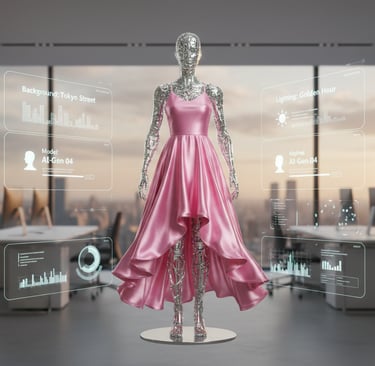
The fashion industry has always been defined by its ability to adapt, evolve, and set the pace for cultural change. Today, that evolution is no longer just about hemlines or color palettes; it is about the very pixels that bring those designs to life. As we move deeper into 2026, the traditional fashion photoshoot—once the undisputed king of e-commerce—is facing a formidable challenger: generative AI.
For decades, the workflow for a fashion brand was rigid and expensive. You designed a garment, manufactured a sample, hired a model, booked a photographer, rented a studio, and spent weeks in post-production. If you wanted to show that same dress on a different body type or in a different setting, you started the process all over again. AI is dismantling this "linear" model and replacing it with a "modular" one, where a single product shot can be transformed into a thousand different marketing assets in seconds.
The Death of the "One-Size-Fits-All" Hero Image
In the old world of e-commerce, brands picked one model to represent a garment. This "hero image" had to speak to everyone, which often meant it spoke to no one specifically. AI-driven on-model photography has changed the math. Brands can now take a "ghost mannequin" shot (a photo of the clothes on a transparent form) and use AI to "wear" that garment onto an infinite variety of synthetic models.
This isn't just about saving money on catering and studio fees. It’s about conversion. Data from early adopters shows that when a customer sees a garment on a model that reflects their own ethnicity, height, and body shape, the likelihood of a purchase increases by up to 30%. AI allows for "hyper-personalization" at scale. A brand can serve a different version of the same product page to a shopper in Tokyo than they do to a shopper in New York, changing not just the model but also the background scenery to match the local vibe.
Beyond the Model: Background Swaps and Atmospheric Lighting
The "vibe" of a fashion shoot is often determined by its location. A linen dress looks better on a sun-drenched balcony in Santorini than it does against a grey paper backdrop in a warehouse in New Jersey. Historically, flying a crew to Santorini was a luxury reserved for high-end editorial campaigns.
AI background replacement tools have democratized high-end production. Using Latent Diffusion Models, brands can now isolate the garment and the model with surgical precision and place them into any environment imaginable. More importantly, these tools don't just "cut and paste." Modern AI understands "global illumination"—it can adjust the shadows on the model’s skin and the highlights on the fabric to match the "Golden Hour" light of a digital sunset. This level of realism is what separates the current wave of AI from the clunky Photoshop composites of the past.
The Efficiency Engine: Speed to Market
In the world of fast fashion and "ultra-fast" fashion, speed is the only currency that matters. If a trend goes viral on TikTok on Tuesday, a brand needs to have a similar product live on their site by Friday. Traditional photography cannot keep up with this pace. The "sample-to-site" pipeline is the biggest bottleneck in the industry.
AI solves this by allowing brands to generate high-quality imagery before a physical sample even exists. By using 3D design files (from software like CLO3D or Browzwear), AI can render photorealistic images of garments that are still in the production phase. This allows brands to "test" demand with pre-orders, reducing overstock and waste—a massive win for sustainability in an industry often criticized for its environmental footprint.
The Flat-Lay Transformation
It’s not just about the models. Even "flat-lay" photography—the art of laying clothes out on a flat surface—is being revolutionized. AI can take a wrinkled, poorly lit photo of a t-shirt taken on a smartphone and transform it into a crisp, professional "e-com ready" asset. It can add natural-looking folds, remove distracting shadows, and ensure color accuracy across an entire collection. For small boutiques and independent designers, this lowers the barrier to entry, allowing them to compete with the visual polish of global conglomerates.
Navigating the Ethics of Synthetic Reality
Of course, this shift brings significant questions. If a brand uses an AI model, are they being "diverse," or are they avoiding the work of actually hiring diverse talent? The industry is currently grappling with the "uncanny valley"—that point where an AI image looks almost human but feels slightly "off." Transparency is becoming a key brand value; many forward-thinking companies are now labeling AI-generated imagery to maintain trust with their audience.
Furthermore, there is the question of "likeness." As AI models become more sophisticated, the line between a "synthetic human" and a "digital twin" of a real person blurs. We are seeing the emergence of new contract types where human models license their digital likeness to brands, allowing them to "appear" in a hundred shoots simultaneously without ever leaving their homes.
The Future: Prompt-to-Storefront
We are rapidly approaching a future where the "storefront" is dynamic. Imagine a website that doesn't just show you a catalog but generates a custom photoshoot for you in real time. You upload a photo of yourself, and the AI "dresses" you in the latest collection, placing you in your favorite vacation spot.
This isn't science fiction; the technology exists today. The challenge for fashion brands in 2026 is no longer "How do we take a good photo?" but "How do we manage our digital identity in a world of infinite imagery?" The brands that win will be those that use AI not just to cut costs, but to create deeper, more resonant connections with their customers through visual storytelling that feels both personal and spectacular.
Frequently Asked Questions
Does AI photography look "fake"?
In the early days, yes. However, with the latest 2026 models, AI-generated fashion imagery is often indistinguishable from traditional photography. The key is "lighting consistency" and "texture retention," which high-end AI tools now handle with incredible detail.
Will AI replace human fashion models?
AI is replacing the "utility" side of modeling—the repetitive, high-volume e-commerce work. However, for high-fashion editorials and brand storytelling, the "human element," charisma, and cultural influence of real models remain irreplaceable.
How much does AI fashion photography cost?
While a traditional professional shoot can cost anywhere from $5,000 to $50,000 per day, AI tools can generate thousands of images for a fraction of that cost, often reducing the "per-image" price by over 90%.
Luxury
Elevate your brand with our exclusive AI models.
Contact us
Exclusivity
© 2026. All rights reserved.
(609) 901-8073