
The Billion-Dollar Fit: How AI is Solving Fashion’s Return Crisis
3/16/20263 min read
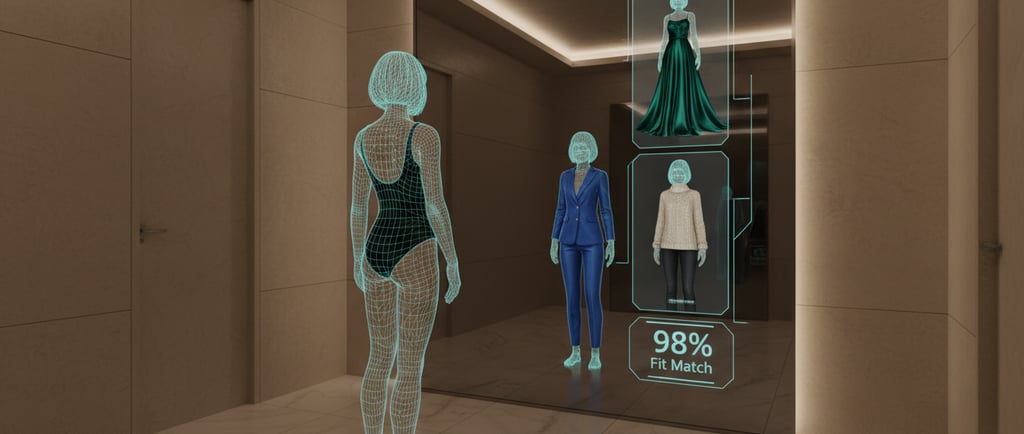
In the world of fashion e-commerce, there is a silent, multi-billion-dollar killer: the return. For every three items sold online, at least one is sent back. In some categories, like high-end denim or formal wear, return rates can soar as high as 50%. The primary culprit? Fit.
For decades, the industry relied on a standardized sizing system that was anything but standard. A "medium" at one brand is a "small" at another and a "large" somewhere else. This inconsistency has led to a consumer behavior known as "bracketing"—buying the same shirt in three different sizes with the intent of keeping one and returning two. While convenient for the shopper, this practice is a logistical nightmare for brands and an environmental disaster for the planet.
Enter Artificial Intelligence. By shifting from "static sizing" to "dynamic fit prediction," AI is finally solving the industry's most expensive problem.
The End of the Size Chart
The traditional size chart—a grid of chest, waist, and hip measurements—is a relic of the past. Most consumers don't know their exact measurements, and even if they did, a 2D chart cannot account for the 3D reality of a human body. AI-powered fit assistants, such as those from companies like Fit Analytics (acquired by Snap) or True Fit, take a different approach.
Instead of asking for inches or centimeters, these AI engines ask for context. They analyze millions of data points from other shoppers: "You are 5'10", 170 lbs, and you usually wear a size 32 in Levi’s? Based on how other people with your profile kept or returned this specific Nike hoodie, we recommend a large." This "collaborative filtering" approach turns every return into a data point that makes the system smarter for the next customer.
Computer Vision and the "Digital Twin"
While data-driven recommendations are powerful, the next frontier is visual. 2026 has seen a massive surge in mobile-based body scanning. Using the LiDAR and high-resolution cameras already in our smartphones, AI can now create a "digital twin" of a consumer with sub-centimeter accuracy.
Apps like 3DLook or Bold Metrics allow a user to take two photos—one front-facing and one profile—and generate a 3D avatar in seconds. This avatar can then be "dressed" in virtual garments that have been digitally mapped for fabric tension and drape. You don't just see if the dress is the right size; you see if it pulls across the shoulders or if the hemline hits exactly where you want it. This level of visual certainty is the ultimate "return killer."
The Hidden Cost of Returns: Logistics and Sustainability
The impact of AI fit prediction goes far beyond the balance sheet. The environmental cost of a return is staggering. A returned item travels twice the distance, requires double the packaging, and often ends up in a landfill because the cost of inspecting, cleaning, and restocking it exceeds the value of the garment itself.
By reducing return rates by even 10%, a global brand can save millions of tons of CO₂ emissions annually. AI is transforming sustainability from a marketing buzzword into a measurable operational metric. When a garment fits perfectly the first time, the entire supply chain becomes leaner, faster, and greener.
Personalization as a Competitive Advantage
Beyond solving the return problem, AI fit data is a goldmine for personalization. If a brand knows your exact body shape and fit preferences, they can curate a "Personal Shop" where every item displayed is guaranteed to fit you.
This removes the "friction of choice." Instead of scrolling through 500 pairs of jeans, the AI presents the five pairs that match your style and your silhouette. This shift from "search and find" to "curate and recommend" is the hallmark of the modern luxury experience, now being scaled to the mass market through AI.
The Future: Bespoke at Scale
The ultimate evolution of AI fit is "on-demand manufacturing." Imagine a world where you don't buy a "size 6." Instead, you buy a design, and the AI sends your precise 3D coordinates to a robotic cutting table that creates a garment specifically for your body.
This "Bespoke for Everyone" model eliminates inventory risk entirely. Brands no longer have to guess how many Smalls or Larges to make; they only make what has already been sold. This is the "Holy Grail" of fashion—a world with zero waste, zero returns, and 100% customer satisfaction.
Frequently Asked Questions
How accurate are AI body scans? Current AI body scanning technology is accurate within 0.5 to 1 centimeter. This is often more accurate than a human tailor using a physical measuring tape, as the AI can account for posture and body volume that a 2D tape measure misses.
Is my body data safe? Privacy is a major focus for AI-fit companies. Most reputable platforms use "edge processing," meaning the photos are processed locally on your phone to create the 3D model, and the original images are deleted immediately, leaving only the anonymous numerical data.
Does this work for all types of clothing? AI fit prediction is most effective for "structured" garments like denim, blazers, and footwear. It is slightly less critical for "unstructured" items like oversized t-shirts or elasticated leggings, though it still helps in determining the desired "look" (e.g., how baggy a shirt will appear).
Luxury
Elevate your brand with our exclusive AI models.
Contact us
Exclusivity
© 2026. All rights reserved.
(609) 901-8073