The Latent Space Atelier: How AI Models are Learning the “Hand” of the Designer
3/2/20264 min read
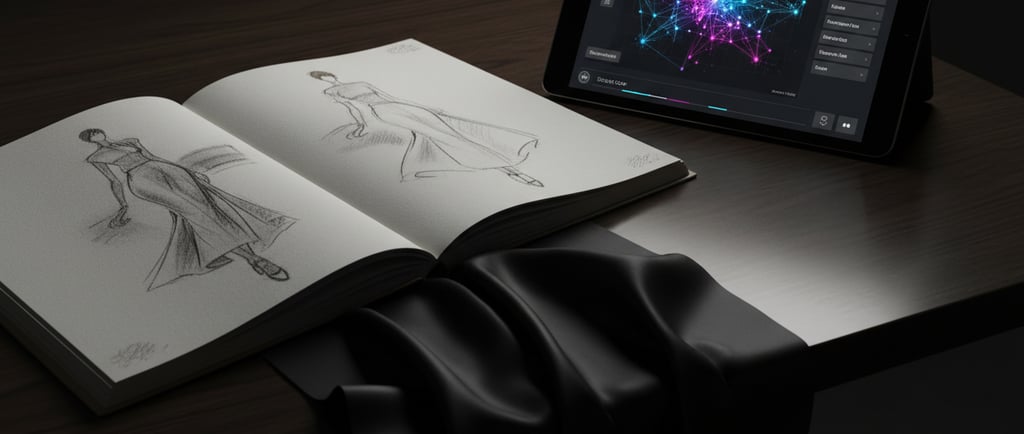
For decades, the "hand" of a designer was considered the ultimate uncopyable asset. It is the specific way a seam curves, the exact tension of a drape, the preference for a certain shoulder structure, and the "logic" of how one fabric transitions into another. In the AI fashion model industry, we are moving past the era of "style transfer"—where an AI simply paints a pattern onto a shape—and into the era of the Latent Space Atelier.
This is a fundamental shift in how AI models are trained. Instead of just looking at the final product (the finished photo), high-end fashion houses are beginning to train models on the design process itself. They are feeding AI the "DNA" of their atelier: the sketches, the patterns, the fit-session notes, and the specific construction rules that make a garment uniquely theirs.
This update explores how "Design DNA" is being encoded into model weights, why this is the new frontier of luxury IP, and how it changes the relationship between the human creator and the synthetic output.
Beyond Aesthetics: Encoding the "Logic" of Construction
Most general-purpose AI models are "surface-level" thinkers. They know what a dress looks like, but they don't know how it’s built. If you ask a generic model to create a "Chanel-style jacket," it will give you tweed and buttons, but it might miss the specific weighted chain in the hem or the exact pitch of the sleeve that defines the house’s silhouette.
The Latent Space Atelier approach solves this by training "Small Language Models" (SLMs) or specialized "Adapters" on a brand’s internal archives. This includes:
Pattern Geometry: The mathematical "blueprint" of how the brand cuts fabric.
Draping Rules: How the brand’s signature fabrics (e.g., heavy silk vs. structured wool) are allowed to fall.
Construction Constraints: Rules that prevent the AI from "hallucinating" impossible seams or gravity-defying silhouettes that the brand would never produce.
By encoding these rules into the model’s "latent space" (the mathematical map of its knowledge), the AI begins to "think" like the designer. It doesn't just generate an image; it generates a proposal that fits within the brand’s established design language.
The Neural Signature: Protecting the "Hand" as IP
In the luxury world, the "hand" is the brand. If anyone can prompt an AI to "make a dress in the style of [Brand X]," the brand’s value is diluted. This is why the Latent Space Atelier is becoming a defensive technology.
Brands are now creating Private Model Weights that act as a digital vault for their design DNA. These weights are not shared with the public. They are used internally to:
Accelerate Prototyping: Designers can "sketch" in the latent space, seeing how a new idea looks when filtered through the brand’s historical construction rules.
Ensure Consistency: Every AI-generated campaign asset is guaranteed to respect the brand’s silhouette, regardless of which agency or creator is prompting the model.
Verify Authenticity: In the future, a brand could use its own "DNA model" to verify if a third-party AI generation is an unauthorized derivative of its style.
This turns the AI model into a living archive. It’s no longer just a tool for making pictures; it’s a tool for preserving the "soul" of the atelier.
The "Co-Pilot" Designer: From Prompting to Sculpting
This technology is changing the role of the human designer. We are moving away from "text-to-image" (which is often a game of chance) and toward "sculpting in the latent space."
In a modern AI-integrated atelier, a designer might use a VR headset or a haptic tablet to "manipulate" the AI model in real-time. They aren't typing words; they are adjusting the "weights" of the design. They might say, "Increase the tension on the waist by 15%" or "Apply the 1994 archive draping logic to this new silk mesh."
The AI acts as a highly skilled assistant that understands the technical constraints of the brand. It handles the "math" of the fabric physics, while the designer provides the "taste" and the "direction." This is the true meaning of the "Centaur" workflow in high fashion: the speed of the machine guided by the "hand" of the master.
The Challenge: Can AI Truly Capture "Taste"?
The skeptics in the industry argue that "taste" is a moving target. A great designer often breaks their own rules to create something new. If an AI is trained only on the past rules of an atelier, can it ever help create the future?
The answer lies in "Fine-Tuning Loops." The most advanced ateliers are constantly updating their models with the latest "human-approved" designs. Every time a designer corrects an AI output, that correction is fed back into the model. Over time, the AI learns not just the rules, but the evolution of the brand’s taste.
What This Means for Agencies and Platforms
For platforms like Noir Starr, the "Latent Space Atelier" represents a shift in service. Agencies are no longer just providing "AI models" (the faces); they are providing "Design Environments" (the brains).
A brand might come to an agency and say, "We want to run a campaign using our authorized digital twin, but we also want the AI to use our proprietary 'Atelier Adapter' so the clothes look exactly like our construction." This requires a high level of technical integration between the brand’s design data and the agency’s generation pipeline.
Conclusion: The Digital Atelier is Open
On Feb 20, the AI fashion model industry is proving that the "hand" of the designer is not being replaced—it is being digitized. The Latent Space Atelier is the bridge between the physical craft of the past and the synthetic scale of the future.
By encoding the "logic" of construction and the "DNA" of design into AI models, fashion houses are ensuring that their legacy remains defensible, consistent, and scalable in a world where "style" is increasingly software. The future of fashion isn't just about what we see on the screen; it's about the intelligence behind the stitch.
Luxury
Elevate your brand with our exclusive AI models.
Contact us
Exclusivity
© 2026. All rights reserved.
(609) 901-8073