
The “Live‑Stream” AI: Real‑Time Generative Video for Social Commerce (and Why Fashion Is Next)
2/9/20265 min read

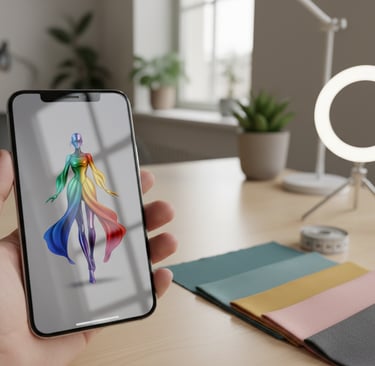
Static AI fashion images had their moment because they solved an immediate pain: brands needed more content, faster, with fewer shoots. But social commerce doesn’t reward stillness. The highest-converting formats are increasingly motion-first: short-form video ads, live shopping streams, shoppable stories, and interactive product demos.
That’s why the next wave is what many teams are converging on conceptually: “Live‑Stream AI”—real-time (or near real-time) generative video systems where a digital model can move in the garment and update the look instantly when a viewer taps a color swatch, selects a size, or switches styling modes (“minimal,” “work,” “night out”).
This article explores what’s changing under the hood—moving from “generate a clip” to “run a responsive video stylist”—and what fashion brands should plan for if they want to compete in social commerce in 2026.
What “Live‑Stream AI” actually means (and what it doesn’t)
When people hear “AI video,” they often imagine a one-click text-to-video tool. That’s useful for concepting, but it’s not yet the same thing as live commerce.
Live‑Stream AI is better described as an experience layer with three requirements:
Temporal coherence: the model’s identity, lighting, and garment details remain stable frame-to-frame (no flicker, no “morphing buttons”).
Controllable variation: the system can change one thing (colorway, layer, accessory, fabric finish) without rewriting the entire scene.
Low latency: changes happen fast enough to feel interactive—ideally within a second or two for “tap-to-change” commerce, and within a few seconds for heavier transformations.
It’s less “make me a fashion film” and more “make a shoppable, responsive visual product demo.”
Why fashion is the perfect (and brutal) test case
Fashion pushes generative video harder than almost any other category because customers subconsciously evaluate:
fit cues (tightness, stretch, drape)
fabric behavior (sheen, weight, movement)
construction details (buttons, seams, collars)
identity trust (the model’s face/hands must not glitch)
color accuracy (especially for neutrals)
A mediocre AI video might be “fine” for an abstract brand ad. But for commerce, even small artifacts can trigger distrust and higher returns: If the fabric moves strangely, customers assume the product will disappoint.
So the prize is huge—and the bar is unforgiving.
The shift: from prompting an outfit to running a “video styling engine”
With still images, you can brute-force with prompting: generate 50 options, pick 5 winners. Video punishes that approach because:
each clip costs more compute than a single image
errors compound across frames
reshoots (regen) are slower and more expensive
consistency matters more than novelty
Live‑Stream AI therefore pushes teams toward systems rather than prompts:
a base motion (walk cycle, turntable spin, sit/stand, “show the sleeve” gestures)
a garment representation (what needs to stay consistent: seams, hem length, texture)
controls (color swap, layer swap, background swap, lighting mode)
a validator (does this still look like the same garment? did buttons move? did the logo appear?)
a latency budget (what can be computed live vs precomputed)
The outcome is less like “content generation” and more like “real-time rendering,” even if it’s powered by generative models rather than traditional 3D.
What’s enabling this: the technical breakthroughs (in plain English)
You don’t need to be a researcher to understand the direction of travel. The key improvements behind the scenes are:
Subheader: 1) Better identity + detail locking across time
Early AI video often suffered from “face drift” and “detail drift.” In fashion, detail drift is deadly: a pocket changes shape, buttons teleport, a pattern swims across the fabric.
Newer approaches emphasize consistency constraints: mechanisms that keep identity and garment features stable across frames while still allowing motion. For commerce, that stability matters more than cinematic creativity.
Subheader: 2) Stronger controllability (pose, camera, edits)
For live commerce, you need predictable motion: a turn, a walk, a sleeve pull, a close-up. That means the system must be steerable via:
pose guidance
camera path guidance
edit-based controls (“keep everything, only change color”)
The “interactive swatch” feature is basically an edit problem, not a pure generation problem.
Subheader: 3) Compute and latency optimization
Real-time-ish experiences require aggressive performance tactics:
smaller specialized models for specific transformations (e.g., color swap)
caching intermediate representations
model routing (fast model for preview, higher quality for final)
quantization and efficient inference kernels
batching and streaming pipelines for many viewers at once
This is why “Live‑Stream AI” is as much an infrastructure story as a creative one.
The commerce experiences this unlocks (the fun part)
Here are the formats that become possible when video is controllable and responsive:
Subheader: Interactive ads: “Tap a swatch, watch it change”
A viewer sees a model walking in the outfit. Tap “espresso” → the coat becomes espresso. Tap “bone” → it becomes bone. The model keeps moving, the lighting stays consistent, and the garment details don’t warp.
Why this matters:
it collapses the funnel: discovery + product exploration in one unit
it reduces friction: fewer clicks to “see it in my color”
it increases confidence: customers understand how the color behaves in motion
Subheader: Infinite runway for drops
Instead of producing one hero video per drop, you generate a continuous stream of on-brand clips:
different models (within brand casting rules)
different backgrounds (studio vs street vs minimal interior)
different styling tiers (minimal vs layered vs accessorized)
The key is that variation is bounded by a style policy, so it doesn’t devolve into random AI outputs.
Subheader: Live shopping hosts + AI co-host visuals
Even without full “AI presenter” video, brands can enhance live streams with responsive visuals:
the host talks while a digital model shows the item in alternate colors
quick cutaways show how it moves when walking or turning
instant “complete the look” pairings shown in motion
This turns the stream into a hybrid: human trust + AI visualization speed.
Subheader: Real-time localization
A single creative can be adapted:
warmer layers for colder regions
different styling modesty norms
different colorways emphasized by region
background environments that feel local (without re-shooting)
For global brands, localization is where margins are won.
The hard part: fashion physics in motion
Video forces the question: Does the garment behave like fabric?
Key failure zones:
sheen drift: satin highlights jump unnaturally across frames
edge shimmer: hems and collars “crawl” due to temporal inconsistency
pattern swim: stripes and checks slide over the surface
impossible folds: fabric creases appear/disappear without cause
body/garment mismatch: garment doesn’t track the body correctly in motion
The practical takeaway: brands will need quality tiers. Not every SKU needs perfect physics. But hero products and high-return categories do.
A realistic implementation roadmap (what brands can actually do)
Most teams should think in stages:
Subheader: Stage 1 — Pre-rendered video variants (fastest ROI)
Generate a small set of clips per hero product (3–5 colorways, 2–3 motions).
Use strict QA: garment details, color accuracy, temporal stability.
Deploy as short-form ads and PDP videos.
This is “near-real-time” in the business sense: you can produce fast without being interactive yet.
Subheader: Stage 2 — Interactive edits on a fixed base clip
Record/generate one base motion clip.
Allow controlled edits (color swap, background change) with tight constraints.
Cache the most popular variants for instant playback.
This is where swatch-tap experiences start to feel real.
Subheader: Stage 3 — True responsive generation (live compute)
Generate variants on demand with streaming inference.
Route preview vs high-quality output.
Add guardrails so the system refuses risky transformations.
This stage requires serious infra and governance, but it’s the long-term differentiator.
KPIs that matter (so it doesn’t become “cool tech”)
If you’re testing Live‑Stream AI for social commerce, measure outcomes that map to revenue and trust:
Thumb-stop rate / 2-second hold
Watch time and completion rate
Tap-to-variation rate (are people engaging with swatches?)
CTR to PDP
Conversion rate lift vs static
Return rate change (especially on fit/fabric-driven categories)
Customer support signals (“color not as expected,” “fabric looked different”)
If returns go up, your video is persuading without informing—dangerous.
Governance, disclosure, and brand safety (non-negotiable)
Once you’re generating fashion video at scale, you need policies:
Disclosure: clear internal rules (and often external labeling) for synthetic visuals
Model/talent rights: no “accidental likeness” issues—use licensed identities
Body and age safeguards: strict controls to avoid sensitive/unsafe outputs
No-logo rules: prevent accidental brand marks appearing on garments/accessories
Audit trails: know which model/prompt/policy produced which asset
Commerce creative is regulated by customer trust; one viral “AI fail” clip can cost more than a quarter’s worth of ad spend.
Where this is headed
In 2026, “AI fashion video” won’t be a novelty. The competitive edge will be responsiveness: video that behaves like a product interface.
The brands that win will treat Live‑Stream AI as a system:
a styling engine with constraints
a rendering pipeline with latency budgets
a QA process that protects fabric truth
and a commerce layer that turns curiosity into confidence
Because in fashion, the point of video isn’t just to look good—it’s to help customers believe, accurately, that the garment will look good on them.
Luxury
Elevate your brand with our exclusive AI models.
Contact us
Exclusivity
© 2026. All rights reserved.
(609) 901-8073