The Multi-Agent Runway: Coordinating 20 AI Models in a Single Synthetic Video
3/11/20263 min read
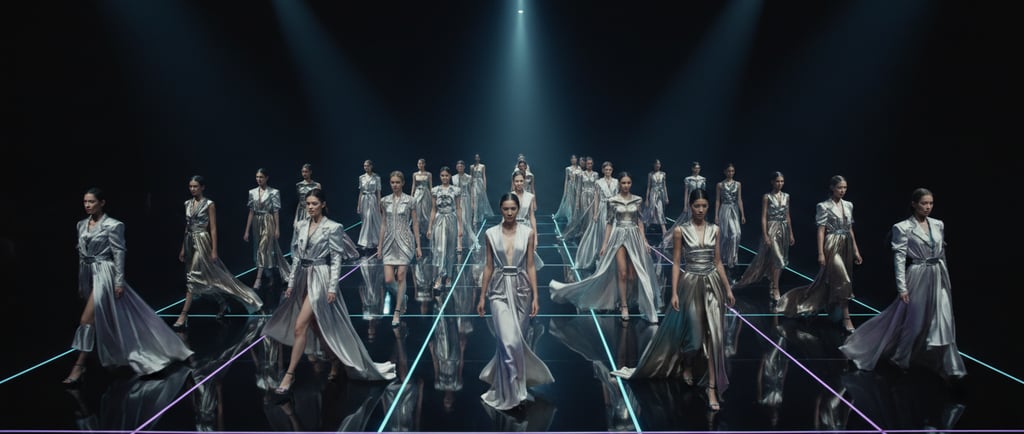
For the first few years of the AI fashion revolution, the industry was focused on the "solo shot." We perfected the single model, the single pose, and the single garment. But as of Feb 20, the AI fashion model industry is tackling its "Final Boss": the Multi-Agent Runway.
This is the technical holy grail of synthetic fashion—the ability to coordinate 20 or more distinct AI models in a single, continuous video, all walking down the same runway, under the same lighting, with perfectly synchronized shadows and garment physics. This update explores how "Multi-Agent Orchestration" is replacing traditional fashion shows and why "Temporal Coherence" is the new metric of luxury production.
The Coherence Challenge: Why Multi-Model Video is Hard
In a single-model AI video, the system only has to worry about one set of "weights." But when you put 20 models in a room, the AI often gets confused. It might accidentally "bleed" the face of Model A onto Model B, or it might struggle to calculate how the shadow of Model 3 should fall across the dress of Model 4.
On Feb 20, the leading platforms are solving this through spatial anchoring. Instead of generating the whole scene at once, they are using "Multi-Agent" systems where each model is its own independent AI agent, anchored to a specific 3D coordinate in a virtual space. This ensures that:
Identity Persistence: Model 7 stays Model 7, even when she walks behind Model 6.
Global Lighting: A single "Light Source" agent dictates the shadows for all 20 models simultaneously.
Collision Physics: The AI understands that if two models brush past each other, their garments must react to the physical contact.
The "Director" Agent: Orchestrating the Synthetic Show
To manage 20 models at once, agencies like Noir Starr are using a new layer of AI: the Director Agent. This is a high-level "orchestrator" that doesn't generate pixels but instead manages the "choreography" of the other AI agents.
The Director Agent handles:
The Walk Cycle: Ensuring all 20 models have a consistent "runway gait" that matches the brand’s aesthetic.
The Camera Path: Coordinating virtual "camera drones" that fly through the scene, capturing close-ups and wide shots in a single take.
The Pacing: Syncing the models' movements to a specific music track or "vibe."
This turns the process of "making a video" into "directing a performance." The human creator isn't editing clips together; they are setting the parameters for a live, synthetic event.
The Death of the Physical Runway?
The economic implications of the Multi-Agent Runway are staggering. A traditional high-fashion show in Paris can cost upwards of $5 million for a 15-minute event. This includes venue rental, lighting, 50+ human models, hair and makeup teams, and travel logistics.
On Feb 20, a brand can produce a synthetic runway show for a fraction of that cost, with:
Infinite Scale: You can have 100 models instead of 50.
Impossible Locations: The runway can be on the moon, under the ocean, or inside a digital cathedral.
Instant Global Reach: The show can be "rendered" in real-time for millions of viewers, with each viewer seeing the models in a personalized environment.
While the "prestige" of the physical show remains, the Multi-Agent Runway is becoming the standard for "Mid-Season" collections, "Pre-Fall" drops, and "Digital-First" luxury brands.
The "Coherence Sync" Metric: The New Standard of Quality
In the "New Talent Economy," we are seeing the rise of a new quality metric: Coherence Sync. This measures how well the AI maintains the "truth" of the scene across multiple agents and frames.
A "High-Sync" production is one where:
There is zero "flicker" in the fabric textures.
The lighting on the models' faces matches the environment 100%.
The interaction between models (e.g., a hand on a shoulder) looks physically real.
For a luxury brand, "High-Sync" is the only acceptable standard. They won't settle for "glitchy" AI; they want a synthetic reality that is indistinguishable from a physical film.
The Future: Interactive Multi-Agent Shows
The next step, which we are already seeing glimpses of on Feb 20, is the Interactive Runway. Because these models are "agents" in a 3D space, the audience can interact with them. A viewer could "pause" the show, walk up to a specific model, and inspect the fabric of their garment in 8K resolution.
This is the ultimate convergence of gaming, fashion, and AI. The runway is no longer a "video" you watch; it’s a "world" you inhabit.
Conclusion: The Symphony of the Synthetic
On Feb 20, the AI fashion model industry moved from "solos" to "symphonies." The Multi-Agent Runway is the proof that AI can handle the complexity, the scale, and the nuance of a full-scale fashion production.
By coordinating dozens of AI agents in a single, coherent environment, brands are unlocking a new level of creative freedom. The runway is no longer limited by the laws of physics or the budgets of the physical world. In the era of the Multi-Agent Runway, the only limit is the imagination of the director.
Luxury
Elevate your brand with our exclusive AI models.
Contact us
Exclusivity
© 2026. All rights reserved.
(609) 901-8073