
The Personalized Lookbook: When the Model on the Screen is You
2/12/20264 min read
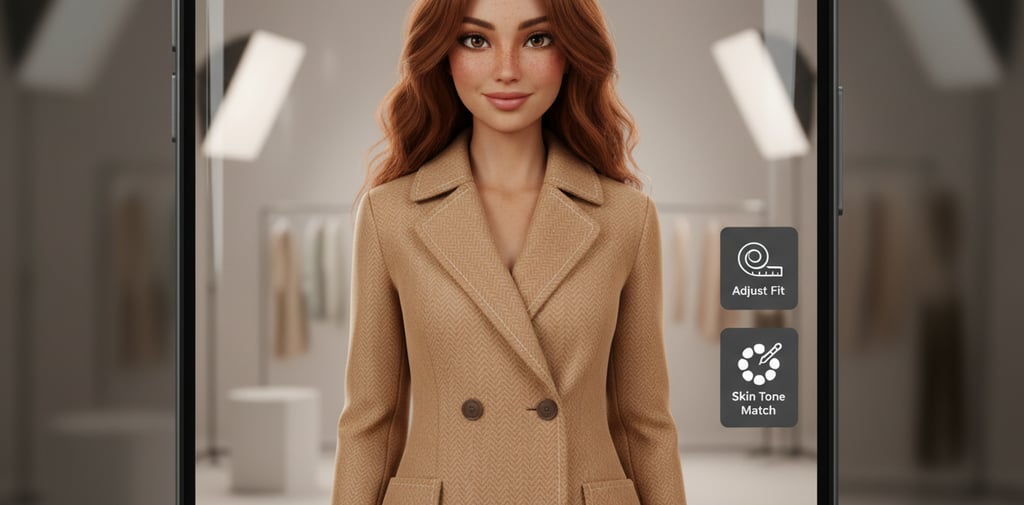
For decades, the fashion industry has relied on a singular, aspirational image: the professional model. Whether in a glossy magazine or on a high-traffic e-commerce site, the "standard" has been a specific height, a specific build, and a specific look. But as we move into 2026, that paradigm is collapsing. The most significant shift in fashion tech isn't just AI generating better models; it’s AI generating you as the model.
The "Personalized Lookbook" is the end of the one-size-fits-all digital storefront. It is a world where every customer who visits a website sees a different version of the homepage—one where the clothes are styled, fitted, and modeled by a digital twin that matches their own body type, skin tone, and height. This isn't just a gimmick; it is the ultimate solution to the industry's two biggest problems: inclusivity and returns.
The Death of the "Standard" Size
The traditional sizing system (S, M, L, XL) is a relic of the industrial revolution—a way to mass-produce garments for a "statistical average" that doesn't actually exist. In the digital age, this system has led to a 30-40% return rate in e-commerce, primarily due to fit issues. Customers are forced to guess how a garment designed for a 5'11" model will look on their 5'4" frame.
The Personalized Lookbook replaces "Size Medium" with "Your Size." By using privacy-first body scanning—often through simple smartphone sensors or a few uploaded photos—brands can now create a secure, private "Fit Avatar" for every customer. When that customer browses a collection, the AI doesn't show them a generic model; it renders the clothing onto their specific avatar in real-time.
This shift changes the psychological experience of shopping. Instead of asking, "Does that look good on her?" the customer asks, "Does that look good on me?"
Privacy-First Body Scanning: The Trust Layer
The biggest hurdle to this technology has always been privacy. Customers are understandably hesitant to share intimate body data with a brand. However, the 2026 landscape has solved this through Edge AI and Zero-Knowledge Proofs.
Modern body-scanning tools process the data locally on the user's device. The brand never "sees" the customer's body; they only receive a set of anonymized mathematical coordinates that describe the silhouette. This "Trust Layer" is what has allowed personalized lookbooks to move from a niche luxury feature to a mainstream DTC standard. Brands like Noir Starr are leading the way by emphasizing that the customer owns their data, and the "Fit Avatar" is a portable asset that can be used across different platforms.
Dynamic Merchandising: A Homepage for Every Body
Personalization goes beyond just fit; it extends to representation. In a traditional shoot, a brand might hire three models to represent diversity. With AI-driven personalized lookbooks, the diversity is infinite.
Dynamic merchandising allows a brand to automatically adjust the skin tone, hair texture, and even the "vibe" of the digital model to match the customer's profile. If a customer has historically purchased warm-toned neutrals and has a deeper skin tone, the AI will prioritize showing the new collection in those colorways, modeled by an avatar that reflects their identity.
This level of hyper-personalization creates an immediate emotional connection. It signals to the customer that the brand "sees" them and has designed specifically for them. It moves the needle from "mass market" to "made for me."
Solving the Return Crisis with "Fabric Truth"
The Personalized Lookbook is only as good as its physics. If the AI makes a stiff denim look like soft silk on your avatar, the return is inevitable. This is where "Fabric Truth" comes in.
By combining body data with high-fidelity material digitization, AI can now simulate exactly how a fabric will drape over a specific curve or stretch across a specific shoulder width. The customer can see if a waistband will be too tight or if a hemline will hit at an awkward spot. This "visual honesty" is the most powerful tool a brand has to reduce returns. When a customer has a realistic expectation of how a garment will fit their unique body, the "surprise" at the doorstep is eliminated.
The Future of the "Digital Closet"
The Personalized Lookbook is the first step toward a "Digital Closet." Once a customer has a Fit Avatar, they can begin to see how new purchases will interact with items they already own. "You own these black trousers; here is how our new blazer looks with them on your body type."
This creates a persistent relationship between the brand and the customer. The brand is no longer just selling a product; they are providing a styling service that is perfectly calibrated to the customer's physical reality.
Conclusion: The New Standard of Inclusivity
The Personalized Lookbook is the ultimate form of inclusivity. It removes the "gatekeeper" of the professional model and puts the customer at the center of the fashion narrative. It acknowledges that every body is a "fashion body" and that the best way to sell a garment is to show it on the person who will actually wear it.
For brands, the ROI is clear: higher conversion rates, lower returns, and deeper customer loyalty. For the customer, the benefit is even simpler: the confidence of knowing exactly how they will look before they ever hit "buy." In 2026, the most important model in the world isn't on a runway in Paris—they're in your pocket, and they look exactly like you.
Luxury
Elevate your brand with our exclusive AI models.
Contact us
Exclusivity
© 2026. All rights reserved.
(609) 901-8073