
The Rise of “Hybrid Shoots”: Merging Human Models with AI-Generated Environments and Garments
1/26/20265 min read
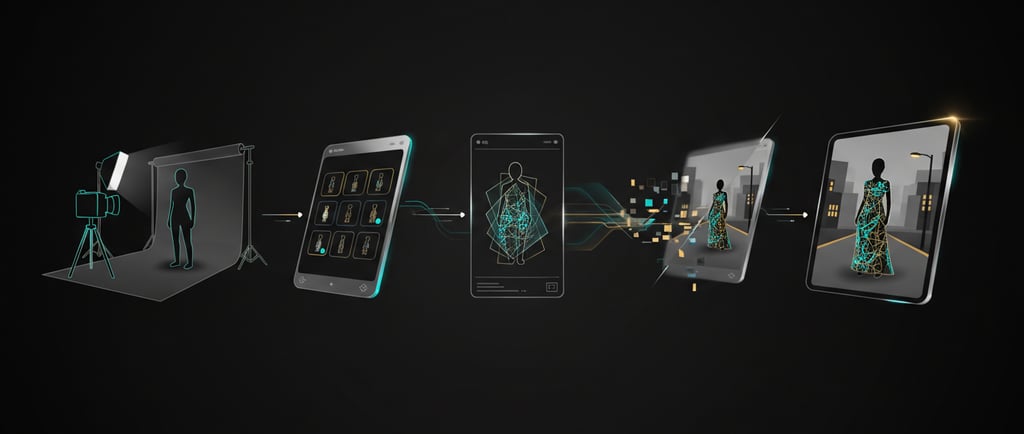
The initial wave of AI in fashion leaned hard into a fantasy: fully synthetic campaigns. AI models, AI garments, AI locations, AI lighting—no studio bookings, no flights, no cast, no crew.
Reality is landing somewhere much more interesting.
Luxury brands, serious retailers, and premium creators are converging on a “Centaur” model:
real human models wearing AI-augmented or AI-generated couture, or
AI models composited into real-world locations and practical sets.
These hybrid shoots combine the trust, nuance, and relatability of human presence with the flexibility and surreal range of AI-generated fashion and worlds.
For a brand ecosystem like Noir Starr—where photoreal virtual models already exist—the hybrid future is about integration, not replacement:
pairing human and AI talent,
blending real sets with digital couture,
and treating generative tools like post-production and styling layers rather than full substitutes.
Below is how the workflow actually looks, why this direction is more realistic for luxury, and how it changes creative strategy.
Why 100% AI Isn’t the Endgame for Luxury
Luxury buyers are not just buying an image—they’re buying:
authenticity (a real person wearing a real object),
credibility (does this garment exist, or could it exist?),
trust (will it look like this on me?),
and aspiration (that subtle human presence you can’t fake easily).
Fully synthetic shoots struggle in a few places that matter deeply to high-end brands:
Believability at scale
One perfect AI image is easy. Ten consistent, brand-correct, fit-accurate, platform-safe images across a collection is much harder.Fit and fabric truth
AI often fakes fabric behavior, strap tension, and micro-interactions that real shoppers notice when zooming in or comparing across shots.Regulation, IP, and platform risk
Platforms and regulators are already moving toward stricter rules on synthetic content, disclosure, and deepfake boundaries—especially around bodies and faces.Human connection
There’s still selling power in “this is a real woman, standing in a real space, looking back at you.” AI can echo that, but right now, it rarely matches it.
Hybrid shoots answer all of that: they retain the anchor of reality and use AI where it’s strongest—design, augmentation, worldbuilding, and scalable variations.
Two Main Flavors of Hybrid Shoots
1) Real Human Models × AI-Generated Garments / Augmentation
The core idea:
shoot a real model in controlled lighting and pose,
then partially or fully replace the garment in post with AI-generated couture or variations.
Use cases:
experimental editorial couture that doesn’t (yet) exist physically
multiple colorways or embellishment options for a single base outfit
avant-garde structures that would be too expensive or fragile to produce physically
moodboards and pre-samples for internal design and marketing alignment
Why it works:
the body, expression, micro-movements, and eye contact are all real
the garment can go beyond the constraints of cost and construction
you can still dial back to something physically producible later
For hybrids like these, the workflow is less “paint over reality” and more “collaborate with it.”
2) AI Models × Real-World Locations / Sets
This is where systems like Noir Starr’s AI models can intersect beautifully with reality. Instead of placing virtual models in purely synthetic fantasy spaces, you:
shoot real locations (luxury apartments, rooftops, hotels, stages),
capture real lighting references and plate photography,
then composite AI models into those backdrops with environment-consistent lighting and perspective.
Use cases:
location-restricted shoots (iconic destinations that are costly or overbooked),
previsualization for campaigns,
filling in gaps when travel or logistics aren’t viable,
testing which environments fit the brand narrative before booking real shoots.
This direction keeps the world real—shadows, reflections, architectural detail—while allowing AI to stand in for cast when needed, or to extend a story around existing shoots.
The Hybrid Shoot Workflow: End-to-End
A modern hybrid shoot usually runs something like this:
1) Concept & Casting (Human + AI)
Creative and production decide:
which looks must be shot on real humans,
where AI garments/variations will add value,
whether AI models (like Noir Starr’s) will be used in parallel or in post.
At this stage, you’re effectively casting twice:
human talent for authenticity and emotional anchor,
AI identities / styles for range, consistency, and scalability.
2) Shooting for Composites: “AI-Aware” Photography
You don’t shoot like a traditional campaign. You shoot with the AI pipeline in mind.
That means:
clean lighting passes (key, fill, rim) for good matting and relighting
neutral base garments (bodysuits, slips, simple cuts) that define silhouette and fit
poses chosen with garment replacement in mind (clear limb separation, minimal occlusion)
reference shots of empty backgrounds, light charts, and gray cards
The goal: give the AI / VFX team clean, structured input—human pose, body volume, and lighting they can work with instead of fight against.
3) Ingestion and Matting
Post-production ingests the shoot into an AI-friendly pipeline:
precise human mattes (segmentation)
depth estimation or manual z-depth for compositing
landmark and pose extraction (skeletons, mesh, or SMPL-like body estimates)
This creates a canvas where garments and environments can be swapped with minimal distortion to the real human form.
4) Garment Generation and Replacement
Now the couture starts to go wild.
Options here:
full garment replacement: the physical outfit is just a “proxy”
partial augmentation: adding train length, sculptural elements, embroidery, crystals
variation generation: alternative colorways, patterns, or surface treatments
Key technical components:
garment-aware diffusion / image models trained on fashion behavior
constraint layers to respect seams, gravity, and fabric physics
preference / quality models that penalize obvious artifacts (melted straps, broken lace, etc.)
For a Noir Starr-like aesthetic, this is where you push:
noir lighting continuity,
attitude and pose integrity,
and garment realism—especially for lingerie, where micro-errors are unforgiving.
5) Environment Compositing and Relighting
For “AI models in real world” or “location-extended” hybrids, you run the reverse:
start from a real environment plate (location photo or video),
match camera parameters (focal length, height, angle),
insert the AI model with:
physically plausible shadows,
reflection passes if there’s glass/metals,
color-grading to match the environment’s atmosphere.
The integration layer here is often more film-VFX than pure generative AI. AI models provide the subject; classic compositing makes it believable.
6) Editorial Polish and Cohesion
Finally, everything passes through:
brand color grade and contrast treatment
subtle grain or halation for luxury feel
small touch-ups to ensure garments and environments feel unified
The hybrid result should feel like a single photographic truth, even when everyone in the room knows how many layers are involved.
Why Hybrid Shoots Are the Most Realistic Path for Luxury
1) They keep humans in the loop
Luxury is built on:
muses,
ambassadors,
real-world iconography.
Hybrid shoots let brands:
protect that human storytelling,
retain celebrity/influencer integrations,
and still benefit from AI’s efficiency and creativity.
2) They satisfy quality expectations
Full-AI pipelines still get caught by:
fabric physics errors,
hand and anatomy artifacts,
inconsistent environment logic,
subtle uncanny valley issues.
Hybrid work starts with a trusted base reality—human expression, real light behavior, or a real environment—and only uses AI to stretch or transform that reality.
3) They’re safer in the coming regulatory landscape
As disclosure rules and deepfake laws tighten, “100% synthetic people” content will carry more friction and risk, especially in intimate categories like lingerie or swim.
Hybrid shoots:
can be anchored around fully consented human talent,
can be clearly disclosed as “digitally augmented,”
and are easier to defend as a natural evolution of retouching and VFX rather than full synthetic replacement.
4) They align with luxury’s craft narrative
Luxury loves craft meets technology:
haute couture with laser cutting,
hand-finished seams guided by digital patterns,
VR showrooms built around hand-draped designs.
Hybrid shoots are narrative gold:
“Shot in Paris, augmented in post with AI couture for a new capsule that blurs physical and digital craft.”
That’s a marketing story customers understand and often celebrate.
Where Noir Starr Fits Into the Hybrid Future
For a brand ecosystem like Noir Starr, hybrid shoots don’t replace AI models—they multiply their roles:
AI models as previs
Use Noir Starr virtual models to previsualize poses, garments, and locations before booking a human shoot.AI models as parallel cast
Run AI-only and hybrid variants of the same concept: a Noir Starr virtual model in the same digital garment line as a human ambassador.AI models as digital doubles
Create AI doubles of real talent (with consent and strict constraints) for:concept exploration,
risky or logistically impossible setups,
or “extended universe” visuals beyond what was shot on set.
Hybrid is not a retreat from AI. It’s AI meeting fashion where it already lives: in the studio, on location, in front of a lens—just with a much more powerful toolbox in post.
Luxury
Elevate your brand with our exclusive AI models.
Contact us
Exclusivity
© 2026. All rights reserved.
(609) 901-8073